

Meta just changed how it decides which ads get a shot at being shown. On October 28, 2026, it announced a new version of Andromeda, a bigger GEM model and a new model called GenRecs. They work together, and they could change what gets your ads in front of the right people. The big takeaway? Having more ads matters less if they're all saying the same thing.
If Andromeda is new to you, start with our guide to Meta Andromeda. Here, we'll look at what's changed, what it means for your ads and what to do with your next creative batch.
What Meta announced on October 28
Meta announced three upgrades on the same day. They each do a different job, but they work together: Andromeda finds ads that might suit someone, GenRecs figures out what each ad is about, and GEM helps predict which ads that person is likely to respond to. There's nothing to switch on. These changes happen behind the scenes in the Facebook and Instagram campaigns you're already running.
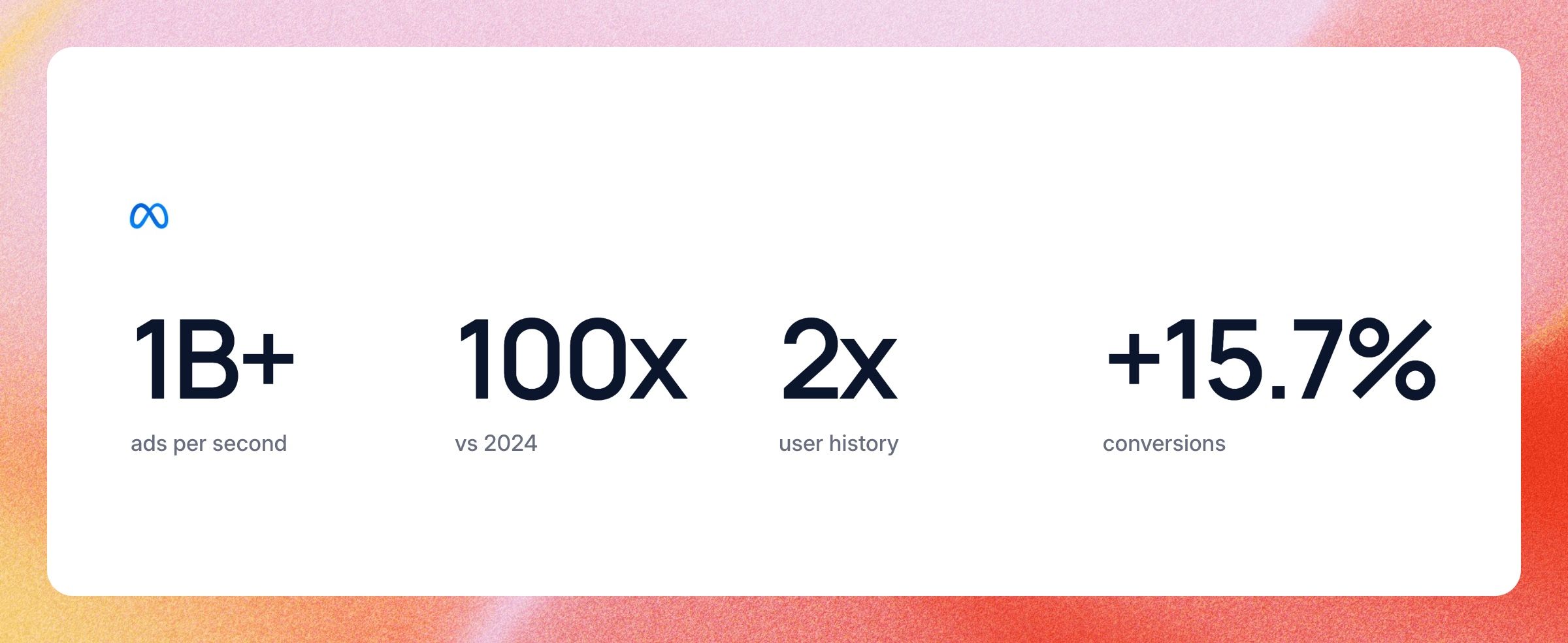
- Andromeda now scores every eligible ad, more than a billion ads per second.
- GenRecs reads the text and images in your ad and describes it in concepts.
- GEM now looks at twice as much of each person's history.
One thing to keep in mind: these numbers come from Meta, and haven't been independently verified. Still, they give us a pretty good idea of where Meta is putting its effort.
Andromeda now scores every eligible ad
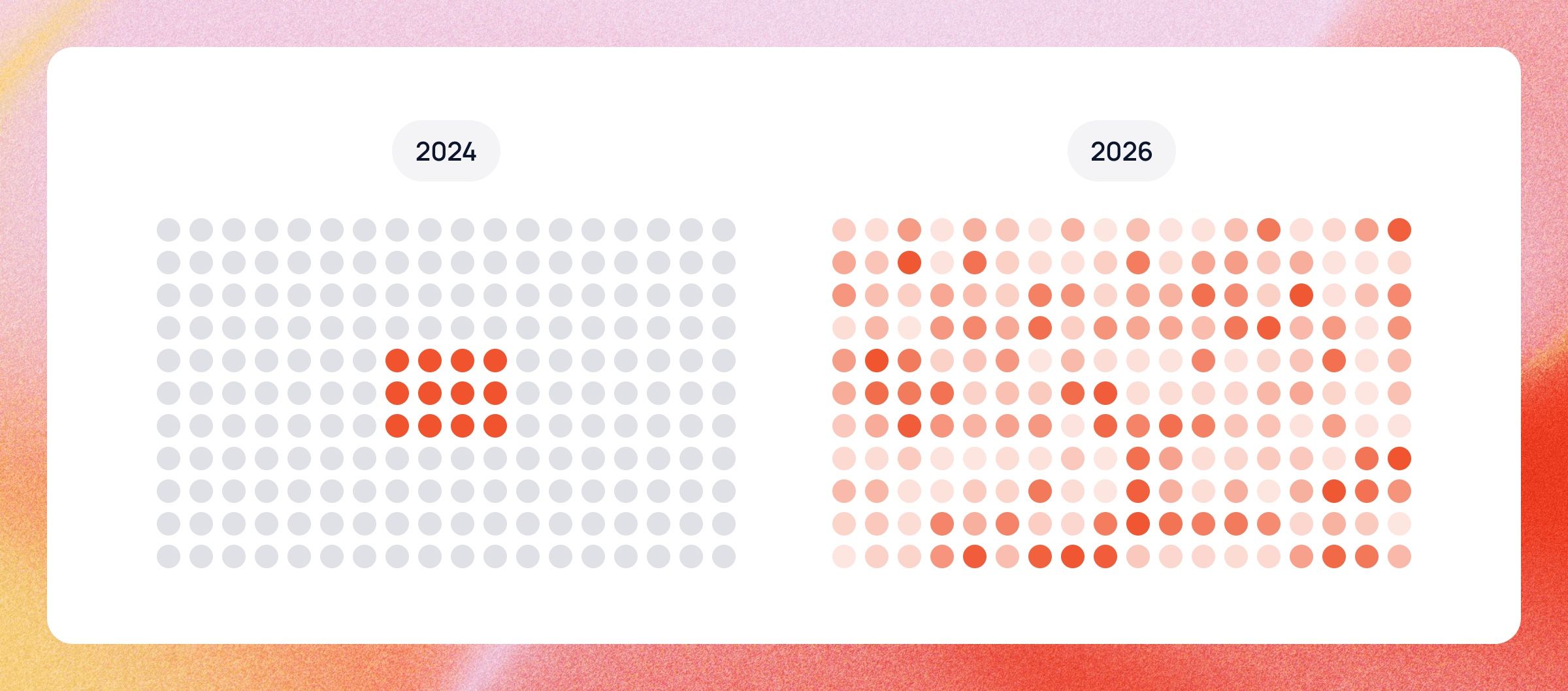
Andromeda is the first step in choosing an ad. When someone opens Instagram, millions of ads could potentially show up. Andromeda has to narrow that huge pool down to a shortlist for the ranking models to look at more closely. The 2024 version took shortcuts to do this quickly: it grouped ads together and skipped most of them.
Now, Meta says it scores every eligible ad for every impression. That's more than a billion ads per second, or around 100 times the capacity of the 2024 system. Meta built it with Nvidia and moved the work onto the same GPU server, so the chips can spend more time scoring ads instead of waiting for data.
It also looks at people differently. Instead of relying on one general picture of each person, Andromeda uses specialist models that each understand a different part of someone's interests. Ads are sent to the models they're most relevant to. That matters because our interests change, overlap and depend on what we're doing at the time.
GenRecs: Meta reads what's in your ad
GenRecs is probably the most interesting part of this update if you work with creative. Until now, Meta's models mostly identified an ad by its ID and the way people had interacted with it. GenRecs actually reads the text and images, then breaks the ad down into details like brand, color, fit and style.
Meta uses the same set of building blocks to describe every ad. So it can tell when a new ad is basically the same idea as one you've run before, and when it's genuinely different. A new ad can also benefit from what Meta has already learned about similar ads, rather than starting completely from scratch.
GenRecs also gives Meta another way to find ads. It looks at the ads and organic posts someone engages with, predicts what else they might like and adds those ads to Andromeda's shortlist. So there are now two ways for an ad to make the shortlist, and both take the creative into account.
GEM: a longer memory of each person
GEM is Meta's large foundation model. It doesn't choose the ads you see directly. Instead, it trains the smaller models that rank ads across Facebook, Instagram Reels and other placements. The new version is bigger and looks at twice as much of each person's history.
What does that mean for your ads? Meta gets a longer view of what each person is interested in. Someone who watched running videos last month and a recipe today can still be seen as interested in both. Meta says GEM has improved conversions by roughly 19% since last year. It also says ranking upgrades drove 8.3% more clicks and 15.7% more conversions on Facebook in Q2.
How an ad gets picked now
Let's follow one ad to see how the new setup works. Someone opens their feed, and Meta has just a few milliseconds to decide what to show. Here's what happens behind the scenes.
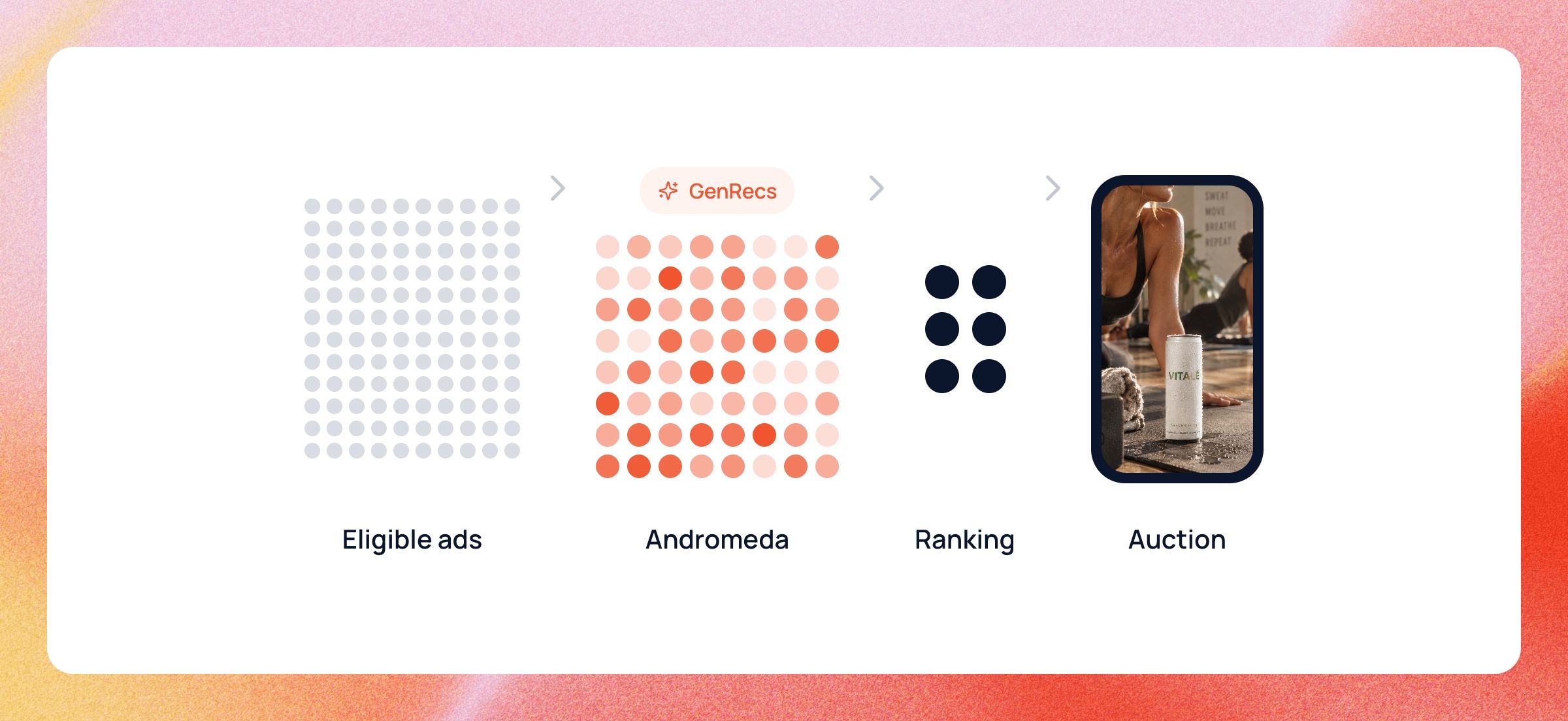
- Eligible ads. Every ad whose targeting, budget and schedule allow it to show to this person.
- Retrieval. Andromeda scores all of them and routes each ad to the specialist models it fits. GenRecs adds its own picks based on what the person engages with.
- Ranking. Heavier models, trained with GEM, predict how likely this person is to click or buy from each ad on the short list.
- Auction. The ads compete on bid and predicted value, and one wins the slot.
Step two is where things really change. In 2024, the system used shortcuts to shrink the pool, so most ads never got properly considered. Now every eligible ad gets scored. Your ad gets its shot, but it still has to be a better match for that person than the other options.
What the update means for your ads
Meta didn't publish a new creative playbook alongside the update. Its announcement focuses on the technology, and it says advertisers don't need to change anything to benefit. But if you look at what these three upgrades do together, a few things stand out for anyone making Meta ads.
- Every eligible ad gets considered.
- Ads that say the same thing can look like one idea to Meta.
- New ads can get a head start, but they still need to learn.
- Your creative has to give people a reason to care.
- There's nothing to switch on, and ad costs are rising.
1. Your ad is up against every other eligible ad
When Meta skipped most ads, an average ad could still get delivery if it happened to be in a group the system selected. Now each eligible ad gets scored on its own. That's good news if you're a smaller brand with a genuinely strong ad: it has a better chance of getting considered.
But it makes life harder for filler ads. Something that's vaguely relevant to everyone can lose to an ad that speaks directly to one type of person. Each ad needs a clear reason to matter to someone.
2. Ads that say the same thing get read as the same idea
GenRecs uses the same building blocks to understand every ad. So if you upload ten versions of the same ad, changing the headline color, button or font, Meta may still read them as one idea. Those versions can share what the system learns about that idea.
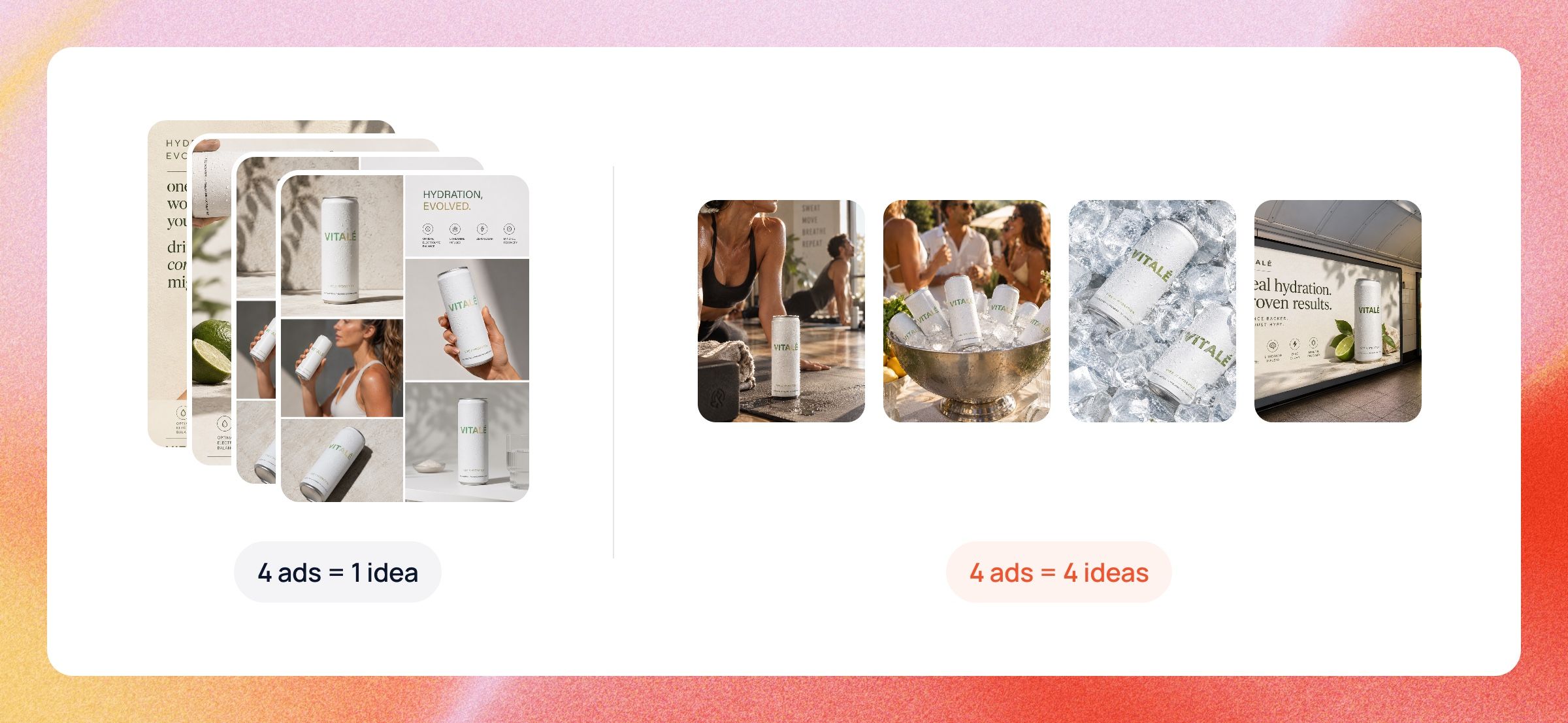
Meta has been recommending creative diversification since its 2025 guidance, telling advertisers to test different themes, messages and visuals. This update helps explain why that matters: Meta now has a model specifically built to understand what an ad is about. Small design changes don't necessarily make it a new idea.
Imagine you sell a hydration drink. Four posters of the can next to a lime, each with a slightly different layout, are basically the same concept. Now compare that with an ad about recovery after yoga, one about a summer party, one showing test results, one comparing it with plain water and one about daily nutrition. That's five different ideas, each giving Meta a different reason to show the drink to someone.
3. New ads get a head start, not a free pass
New ads used to have very little to go on. Meta had to show them to people, wait for reactions and figure out who they might work for. Now GenRecs can read the ad itself and use what Meta knows about similar ads and products. That can help a new concept find its audience sooner.
That doesn't mean the learning phase disappears. Meta's ads infrastructure lead has been clear that the system still needs to test new ads with real people. A new concept may find its audience faster, but give it a fair test before deciding whether it works.
4. Targeting matters less, and the reason to buy matters more
Matt Steiner, who leads ads infrastructure at Meta, put it bluntly in an interview with AdExchanger: "The importance of targeting is diminishing over time." In other words, Meta's models are getting better at finding the right people. Your job is to give them a clear strategy and a reason for those people to care.
That doesn't mean you can stop thinking about your audience. It means more of that thinking needs to happen in the creative itself. Andromeda's specialist models look at different interests, and GenRecs helps them understand what your ad is saying. If every ad is about "great taste, zero sugar," you're giving Meta the same reason to show it every time.
5. There's no switch to flip, and costs are rising
You won't find an Andromeda 2.0 switch or a new report in Ads Manager. The changes happen through normal delivery. So if your results look different in early November, the update could be part of the reason. Your offer, tracking and seasonal changes could be factors too.
Meanwhile, advertising is getting more expensive. Meta's Q3 2026 figures show the average price per ad was up 14%, while impressions rose 10% worldwide. When every impression costs more, there's even less reason to spend money showing people the same idea over and over.
What to do in your next batch
You don't need to rebuild your campaigns. What you do need is a better way to plan and review your creative. Start with these five habits.
- Count concepts, not ads.
- Build each concept from a reason to buy, a moment and a doubt.
- Put the idea in the picture and the first line.
- Watch where the spend goes.
- Give each new concept a fair test.
Count concepts, not ads
Before briefing your next batch, go through your live ads and write one sentence about each. Then group together the ads that are saying the same thing. Each group is one concept. You'll probably find you have fewer concepts than ads.
Say you have 24 ads, but they boil down to five different ideas. That's five concepts, not 24. Your next batch should aim to add a sixth or seventh concept, rather than making a 25th version of what you already have. You can make this easier to track by putting the concept in each ad name, like "C07_vs-water_static_v2".
Build each concept from a reason, a moment and a doubt
"Better hydration" is too broad to build an ad around. Get more specific: why would someone buy it, when would they need it, and what's making them hesitate? Write down all three before you start filming or designing.
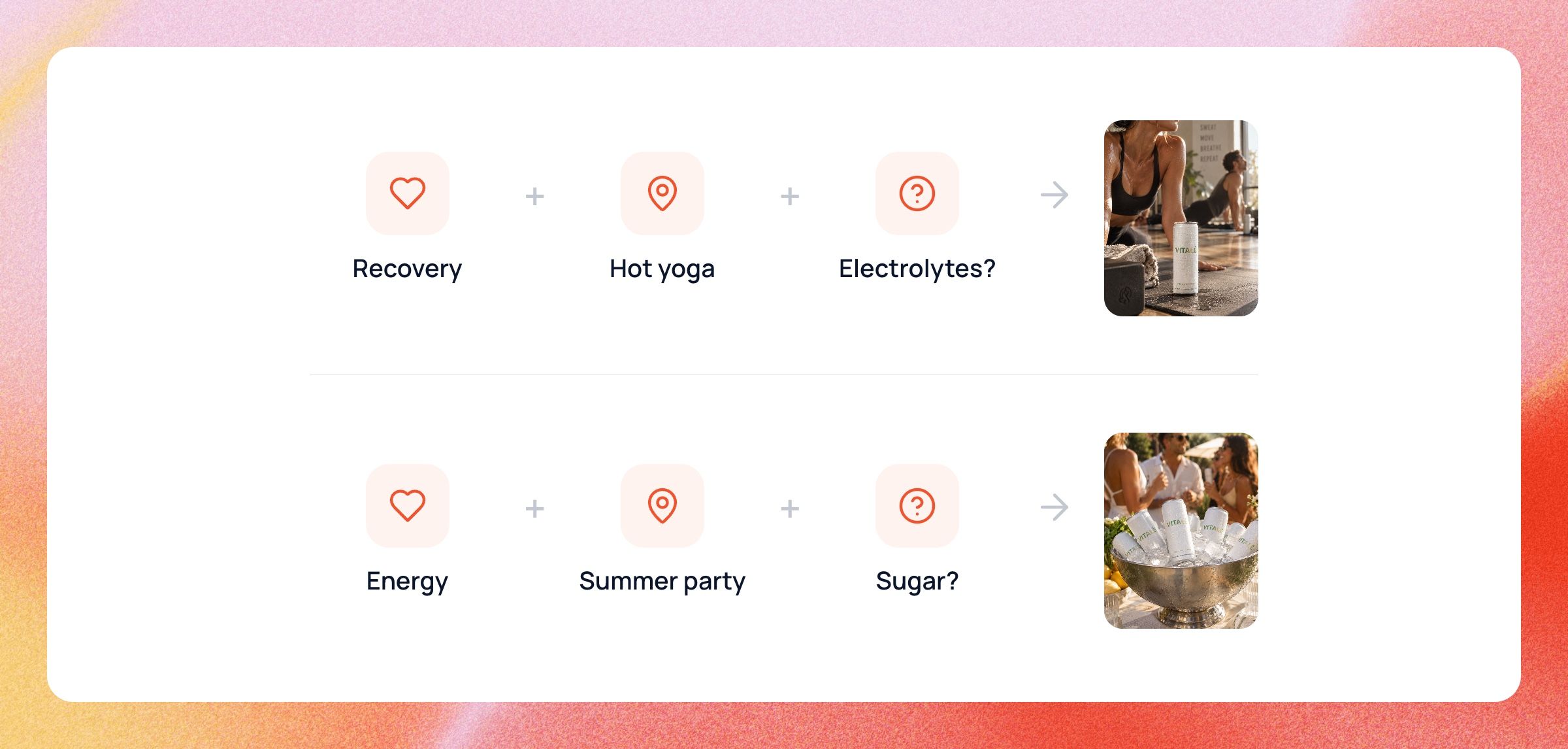
For the drink, one concept could be: recover faster, after a hot yoga class, for someone who isn't sure electrolytes actually do anything. Another could be: feel good at the party, after a long day in the sun, for someone avoiding sugar. Different situations, different doubts, different people to reach.
Put the idea in the picture and the first line
GenRecs reads your ad's text and images. Make the idea clear in the first frame and the first line. Don't hide it in a voiceover 20 seconds in. If the ad is about recovering after yoga, show someone after yoga.
Here's a quick way to check whether two ads are actually different: put their first frames and first lines next to each other. Can you tell what each ad is about straight away? If not, Meta may struggle to tell them apart too.
Watch where the spend goes
When your ads look alike, check where the budget is going. Often, one or two older ads take most of the spend while the new ones barely get a look. Meta may see them as more versions of an idea that's already working. It could be a sign that your new ads aren't different enough.
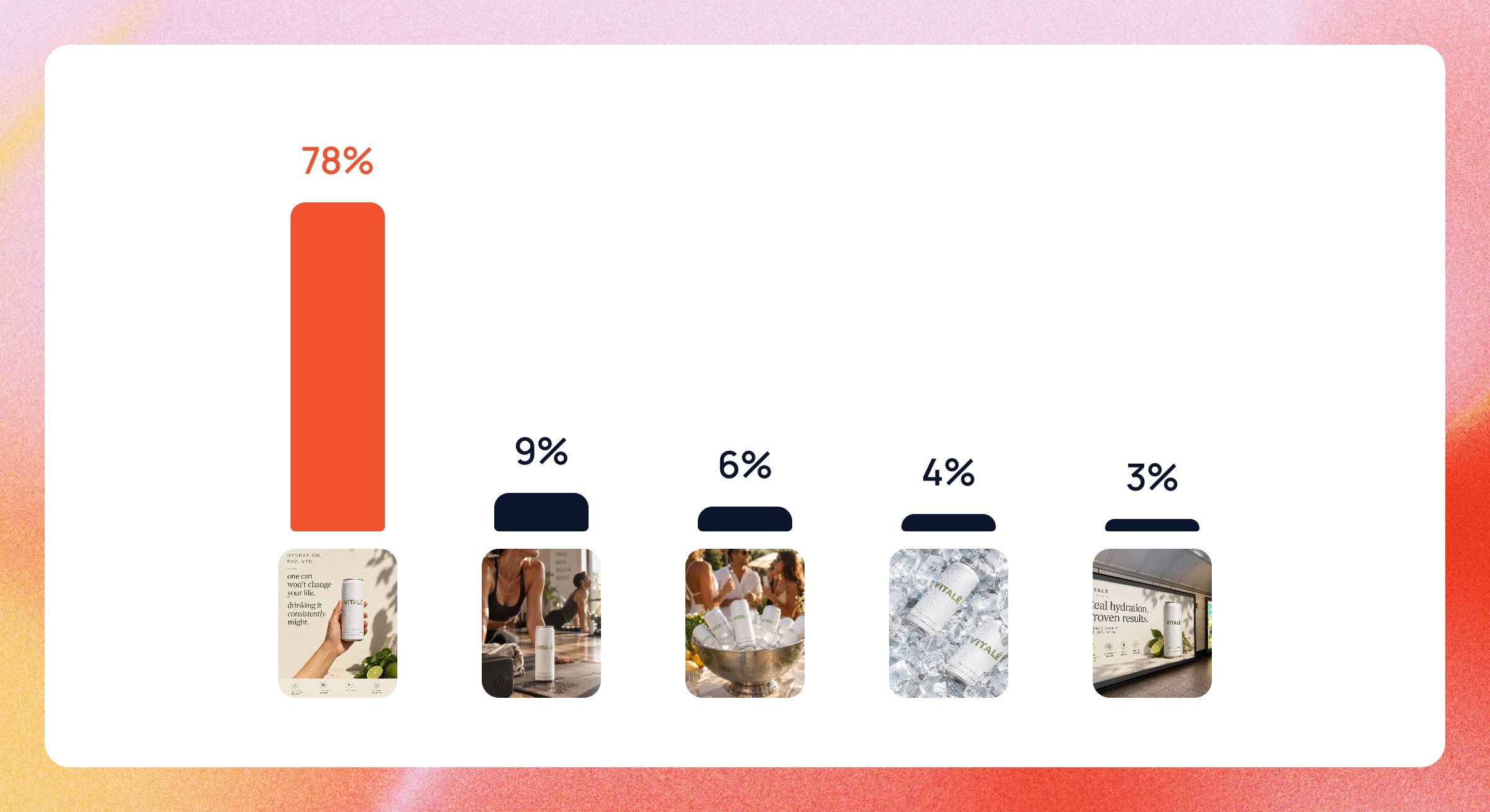
Look at performance by concept, not just by individual ad. Add up the spend, results and cost per result for each group. If one concept keeps taking 70% or more of the budget for weeks, it's probably time to test some new ideas instead of making more versions of the same one.
Give each new concept a fair test
GenRecs may help a new concept get going, but it still needs time to prove itself. Don't turn it off after two days just because your old winner is getting all the spend. Give it a fair budget and enough time to find the right people, then compare its cost per result with your other concepts.
Keep a few new concepts ready before you need them. Even a winning idea gets tired eventually, and when fatigue hits, it can affect every version of that concept at once. We explain how to spot it early in our guide to ad fatigue.
What the update didn't change
It's tempting to blame every change in performance on the algorithm. But plenty hasn't changed. Meta says your targeting rules still work the same way, and your offer, landing page and tracking still have a big say in what happens after someone clicks.
Simply making more ads won't fix it either. If all 30 ads are built around the same idea, Meta still has one idea to work with. What matters is the thinking that goes into the creative before anyone starts making it.
Also, remember that Meta's numbers are averages across Facebook. Meta says Andromeda has lifted Facebook conversions by 2.4% since 2025. That's huge for Meta overall, but it doesn't tell you what happened in your account. Look at your own results over a consistent period rather than expecting to see the same lift.
How this works in Lemonado
Lemonado connects your Meta ads with the rest of your marketing stack, so your team can look at everything in one place. Three parts are especially useful here: Creatives, Chat and Routines. Together, they help you see your ads by concept, which is hard to do in Ads Manager.
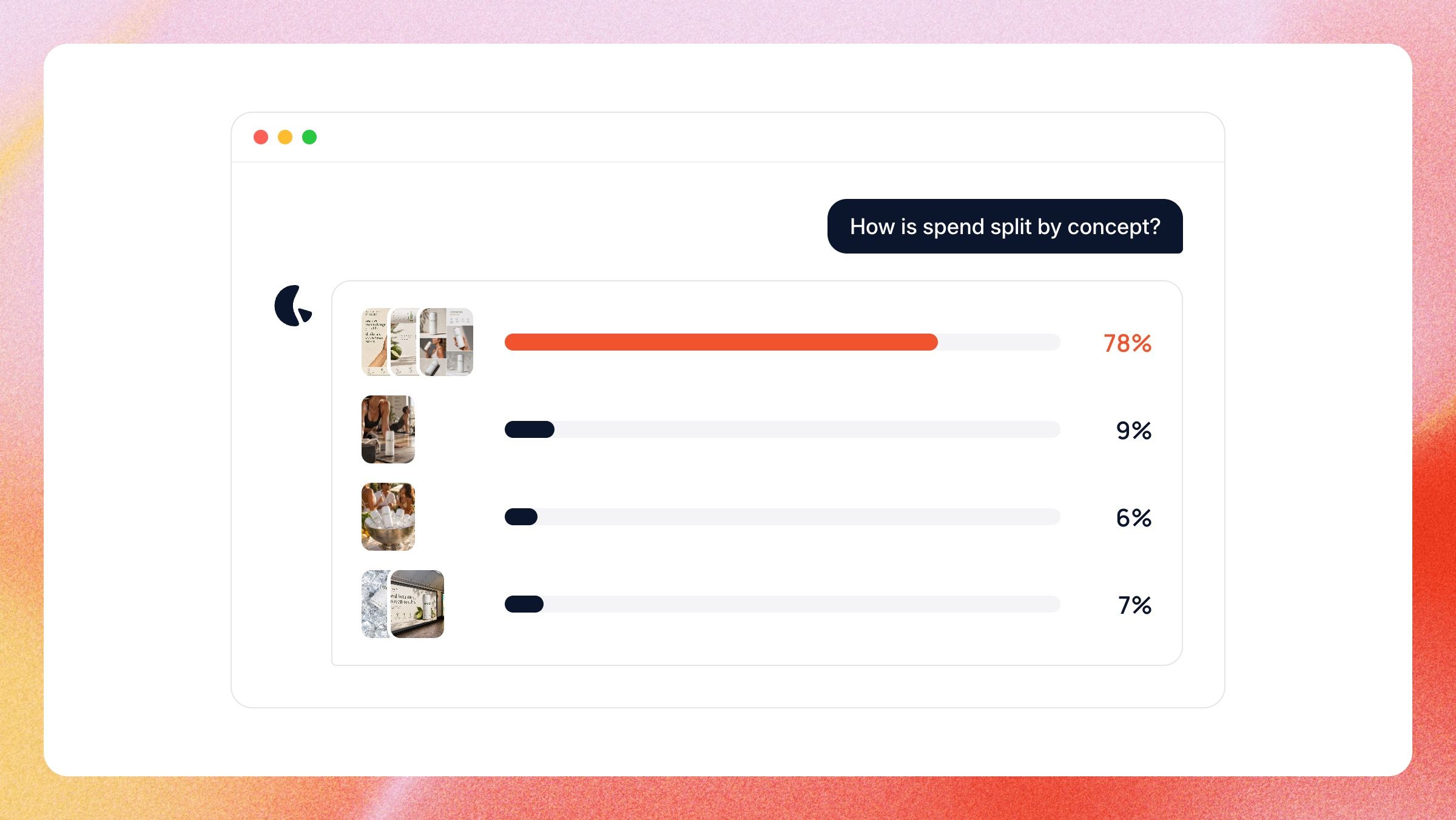
Creatives breaks down your ads by hook, angle, format and offer, and shows hook scores and fatigue across Meta, Google, TikTok, LinkedIn, Pinterest and Snapchat. You can quickly spot when ten ads are really the same concept, see what's missing and check which ideas your competitors are using.
In Chat, just ask: "Compare my Meta ads from last month by hook and angle, and show how spend was split between them." Lemonado groups the ads and shows you the spend and cost per result for each concept. You can also use Routines to check this every morning and get a message in Slack if one concept takes more than half of an ad set's spend for a week.
Do this with AI
You can do this check yourself, too. Export your live Meta ads with their names, ad sets, copy, spend and results. Add a short, honest description of what's shown in each image or video, then paste everything into an AI chat with the prompt below. Do it once a month or before your next creative brief.
I'm pasting my live Meta ads below: ad name, ad set, primary text, headline, a short description of the image or video, spend, results and cost per result for the last 30 days. 1. Group the ads into concepts. A concept is the reason to buy, the moment and the doubt the ad speaks to. Ads that only differ in color, font, button or a small headline change belong to the same concept. 2. For each concept, write one sentence that describes it, and add up spend, results and cost per result. 3. Flag any concept with more than 50% of spend, and any ads that look like cosmetic versions of another ad. 4. Give the account a creative variety score from 1 to 5 and explain why. 5. Suggest five new concepts I'm not running yet. For each one, give the reason to buy, the moment, the doubt it answers, and what the first frame and first line should show. Return a table, then a short summary I can paste into Slack.
The more specific your descriptions, the better the result. "Woman drinking the can after a yoga class" is useful. "Lifestyle image" isn't. It doesn't tell you what the ad is actually showing, which is the whole point of this exercise.
FAQs
Still have questions? Here are the things marketers are most likely wondering about the October update.
What is Andromeda 2.0?
Andromeda 2.0 is the name marketers use for the updated version of Meta's ad retrieval system, announced on October 28, 2026. Meta says it scores every eligible ad for every impression, at more than a billion ads per second, and sends ads to specialist models based on people's interests. The update also includes a bigger GEM model and a new model called GenRecs.
When did the Andromeda update happen?
Meta first introduced Andromeda in December 2024. It announced the new version on October 28, 2026. Meta's Q3 notes also credited Andromeda improvements with 1.4% more conversions on Facebook. There's no single date when you need to turn it on; the changes are part of Meta's normal ad delivery.
Do I need to change anything in Ads Manager?
No. There's no new setting or report to look for. Focus on your creative instead: test genuinely different concepts, make each one clear in the image and first line, and review performance by concept rather than just by ad.
What is GenRecs?
GenRecs is a recommendation model that uses language models to understand your ads. It reads the text and images, then describes them using a shared set of concepts rather than just an ID. That helps Meta understand how a new ad relates to ads it already knows. It also finds more potential ads based on the ads and posts someone engages with.
Does Andromeda 2.0 mean I should run more ads?
Not necessarily. More ads only help if they bring new ideas. If they all say the same thing, Meta may treat them as one concept. Five genuinely different concepts can be more useful than 30 versions of the same ad.
Why do my new ads get almost no spend?
One possibility is that Meta sees them as more versions of an older ad that's already working, so most of the budget stays there. Look at whether your new ads offer a different reason to buy, speak to a different moment or answer a different doubt. If they don't, you probably need a new concept, not a bigger budget.
Get started
The October update makes one thing pretty clear: your creative does more of the targeting work now. Lemonado shows your ads by concept, how your spend is split and where the gaps are, across all the platforms you advertise on. Connect your Meta account and start exploring your creative in a few minutes.
Try Lemonado free. We front you $150 in credits for up to 10 days, no card needed.