

If your Meta account runs 40 ads and only three of them ever get real spend, Andromeda is often part of the reason. It's the system Meta uses to decide which ads get a chance to show at all, and advertisers widely report that it gives little room to ads that are basically the same.
This guide covers what Meta Andromeda is, what the update changed for advertisers, and what to do about it. It sticks to what Meta has published, flags what it hasn't, and shows how to set up your account and your creative so the system has real choices to make.
What is Meta Andromeda?
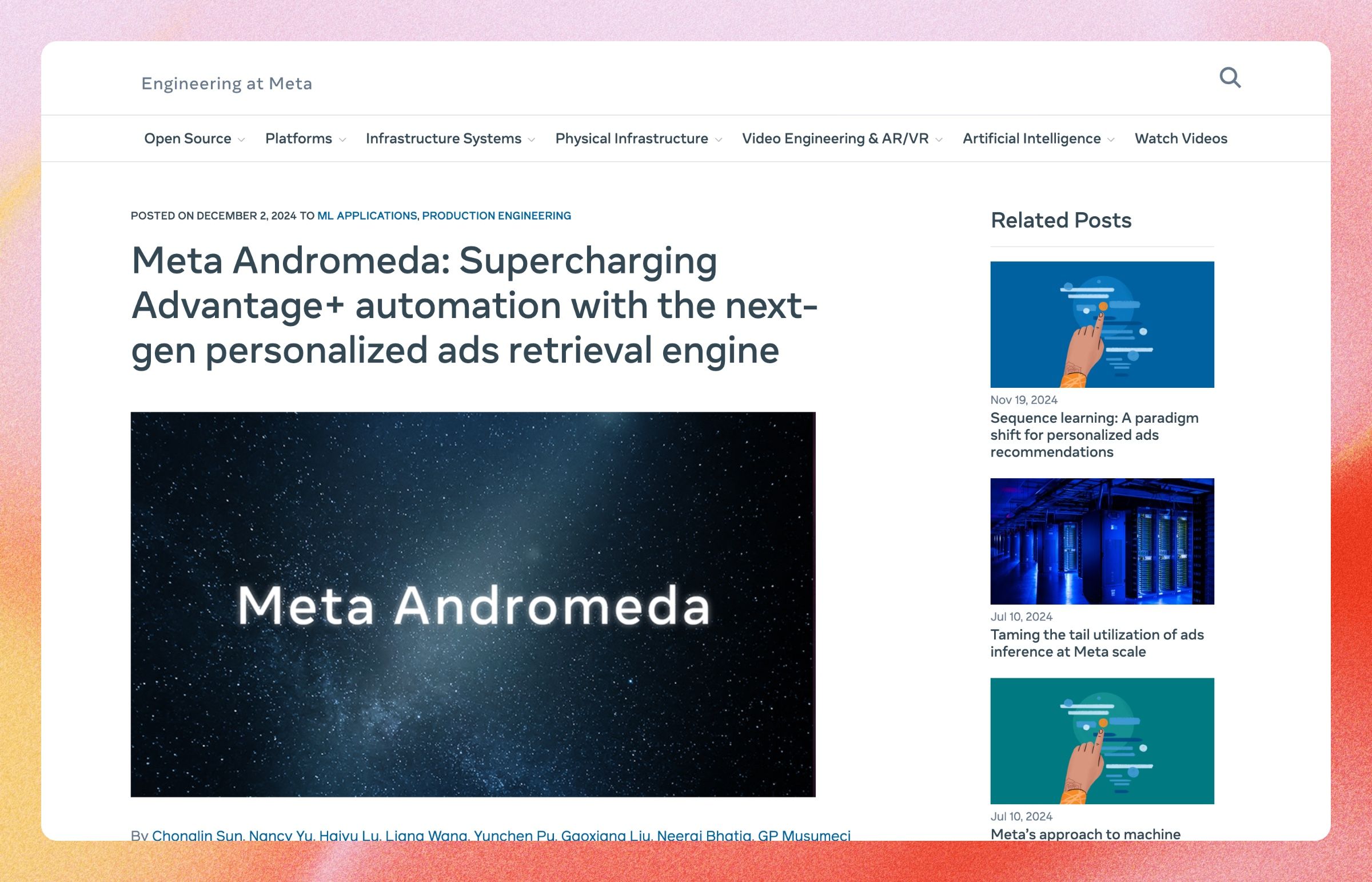
Meta Andromeda is the engine Meta uses to pick which ads a person could see. Meta calls it its next-generation personalized ads retrieval engine, and it introduced it on Meta's engineering blog in December 2024.
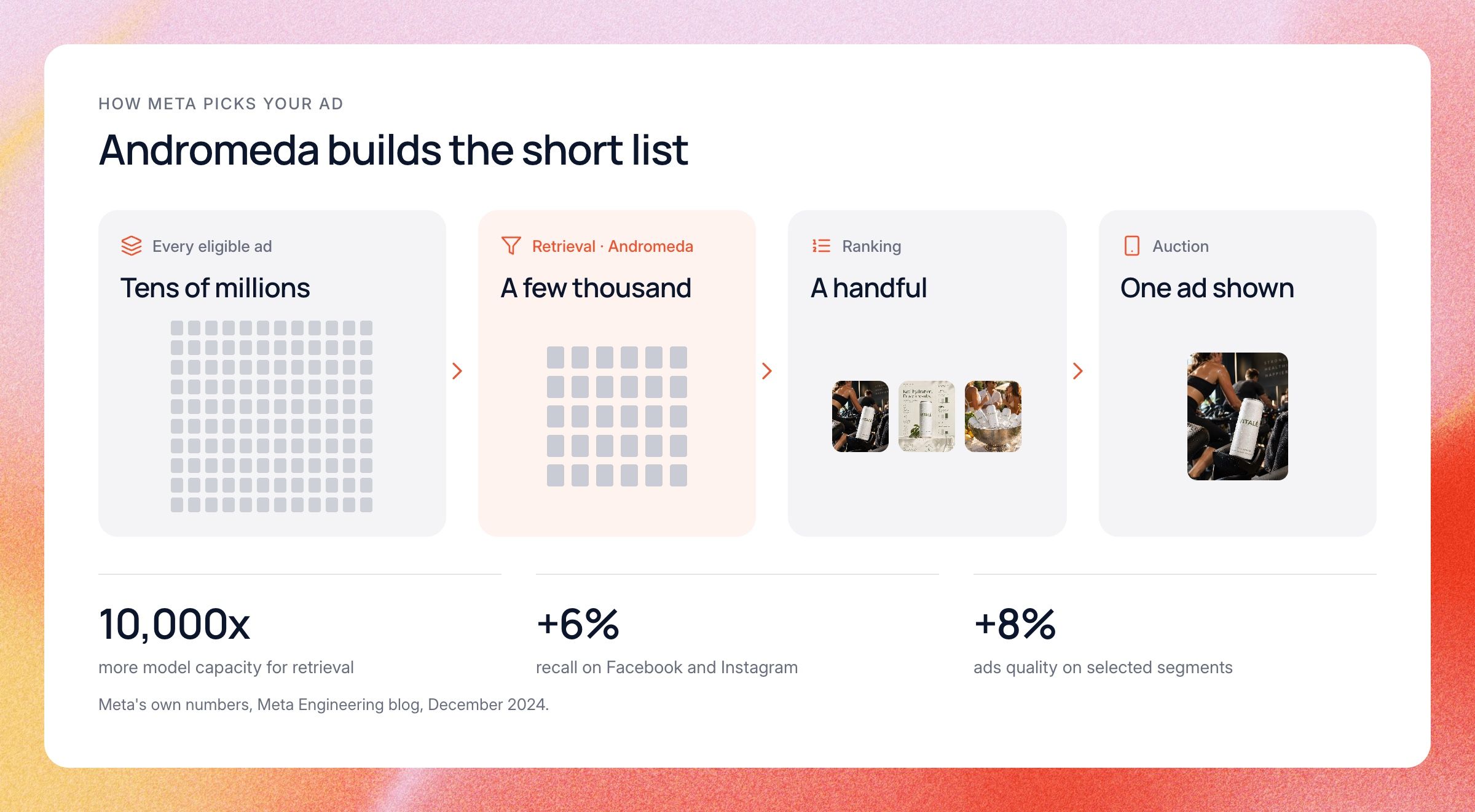
Every time someone opens Facebook or Instagram, tens of millions of ads could in theory show up. Meta can't run its heaviest models on all of them in the split second it has, so it works in stages. Retrieval comes first and cuts the pool down to a few thousand candidates. Ranking comes next and picks the ads that go into the auction.
Andromeda is the retrieval step, the one that builds the short list. Ranking then picks the winner from that list. If your ad doesn't make the short list for a person, it never gets a chance with them, no matter how good your bid or budget is.
How Andromeda works, in plain words
Meta rebuilt retrieval around a much bigger deep neural network, a layered (hierarchical) index of ads, and hardware that pairs NVIDIA's Grace Hopper Superchip with Meta's own MTIA accelerator. The goal was to weigh far more detail about each person and each ad, fast enough to happen in real time. Meta shared a few numbers in its engineering post:
- 10,000x increase in model capacity for retrieval
- +6% recall across Facebook and Instagram, meaning it finds more of the ads that are relevant to a person
- +8% ads quality on selected segments
Those are Meta's own numbers, and they describe the system, not your account. For you, the useful part is the direction. Retrieval can now weigh far more signals about each ad and each person, and Meta is asking advertisers for varied creative so it has more to match.
Andromeda and GEM
You'll also hear about GEM, Meta's Generative Ads Recommendation Model, which Meta described in a November 2025 engineering post. GEM is a large foundation model that Meta uses to teach and improve the many ads models that decide what people see. Andromeda builds the short list, and models improved by GEM help choose from it. Both lean the same way, with the content of your ad doing more of the targeting work and your audience settings doing less.
What the Meta Andromeda update changed for advertisers
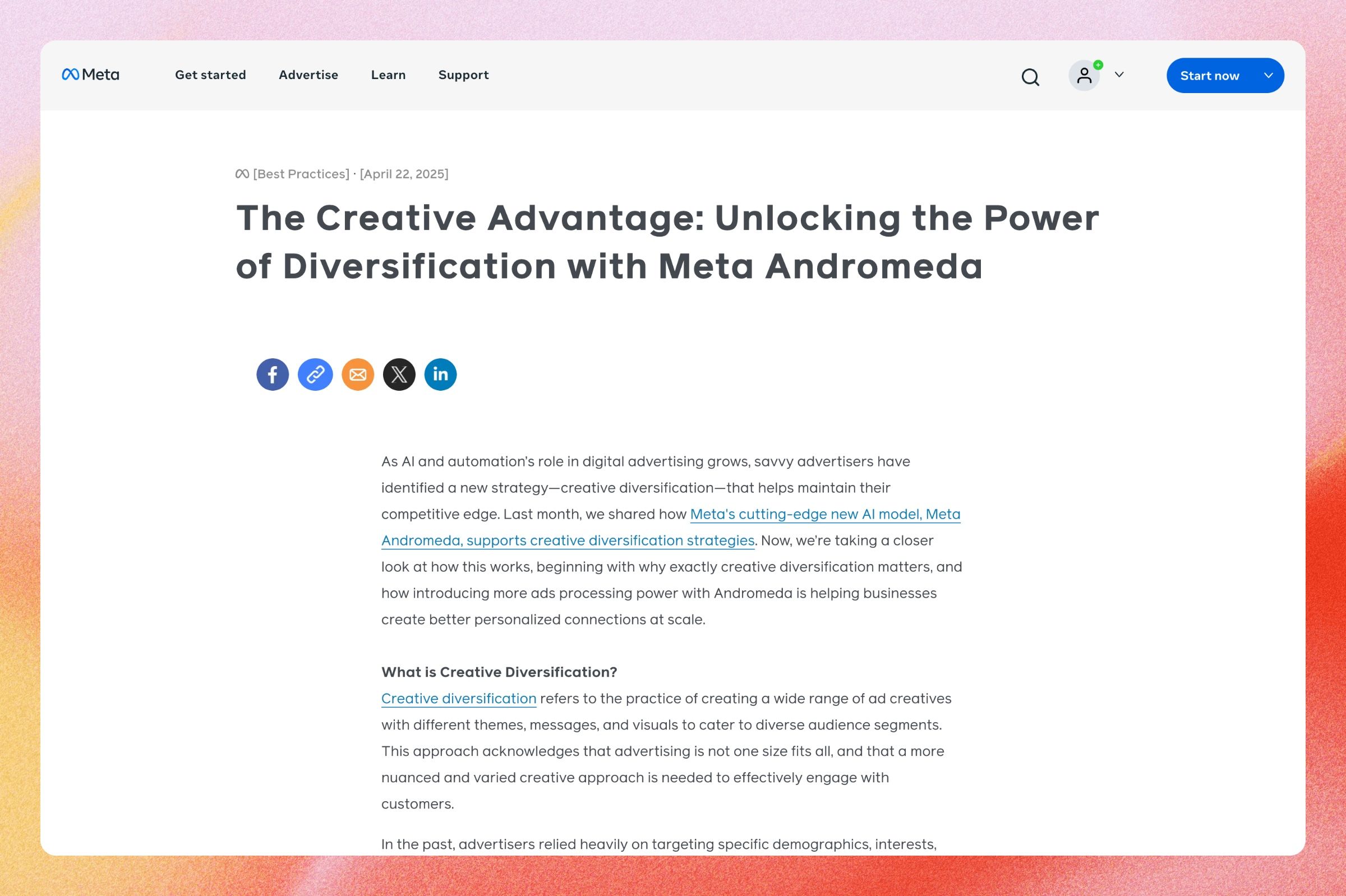
Meta said it plainly in an April 2025 post for advertisers. It recommends uploading a wide range of creatives with different themes, messages and visuals, so its AI can figure out who each one is for. You can read it in Meta's post on creative diversification. Meta's engineering post says Andromeda was already running on Facebook and Instagram when it was announced, but there was no single "update day" for advertisers, so many felt their accounts change gradually through 2025.
Here's what that means in practice for most accounts. Only the first point comes straight from Meta. The rest is what advertisers have learned since.
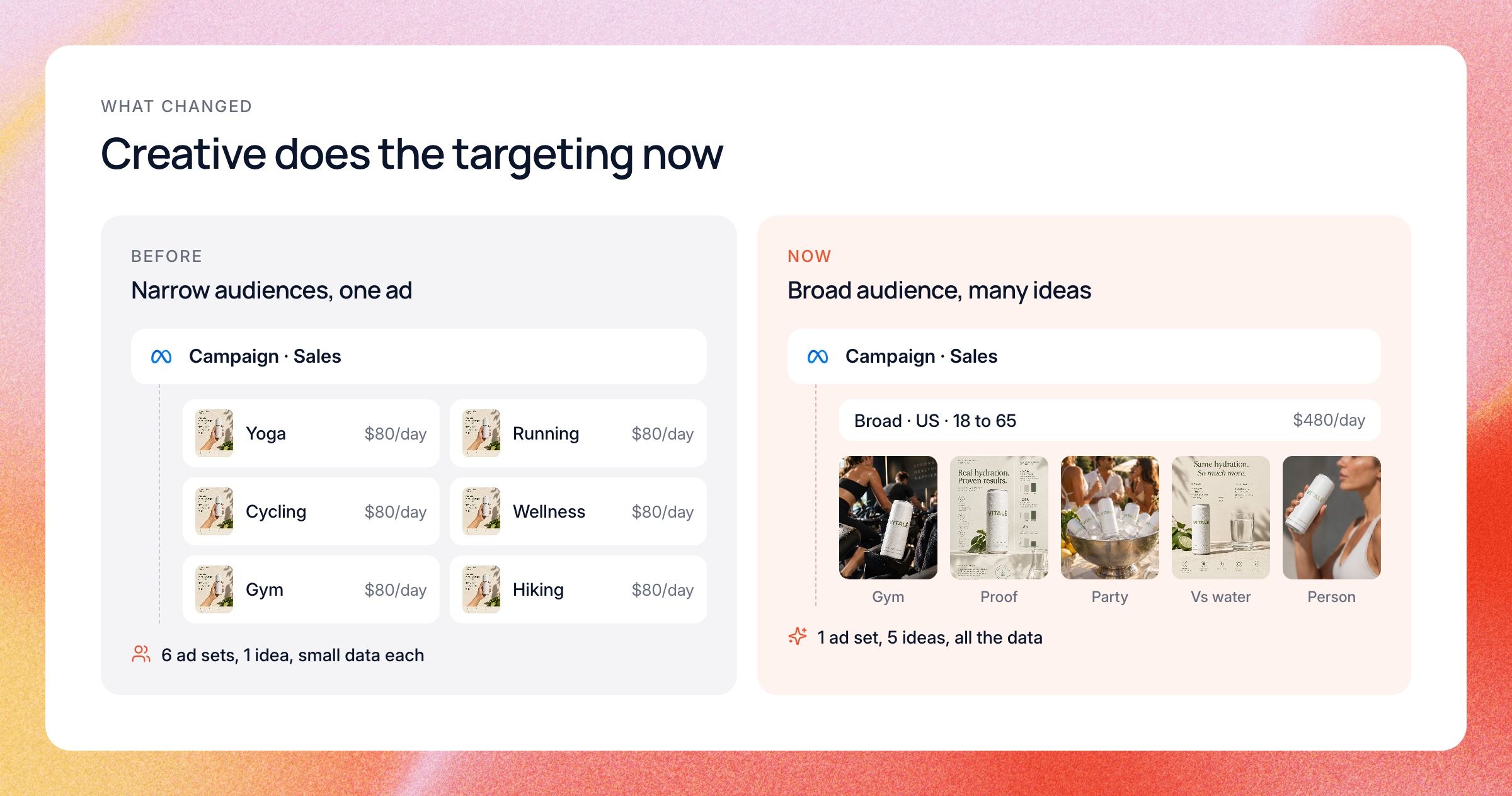
- Creative is now your targeting. Meta's April 2025 post calls creative diversification the main way to reach the right people, ahead of narrow targeting.
- Near-copies likely count as one idea. Ten versions of the same video with different text don't give you ten chances.
- Fewer, broader ad sets work better. Splitting budget across many narrow ad sets gives each one less data to learn from.
- Interest stacking matters less. Broad targeting plus varied creative usually beats narrow targeting plus one idea.
The near-copy point is the one that hurts most teams. Media buyers call this grouping an "Entity ID", the idea that Meta treats look-alike ads as one entity. That name is industry shorthand. Meta hasn't published how it groups ads or at what level of similarity, so be careful with anyone who quotes you an exact percentage.
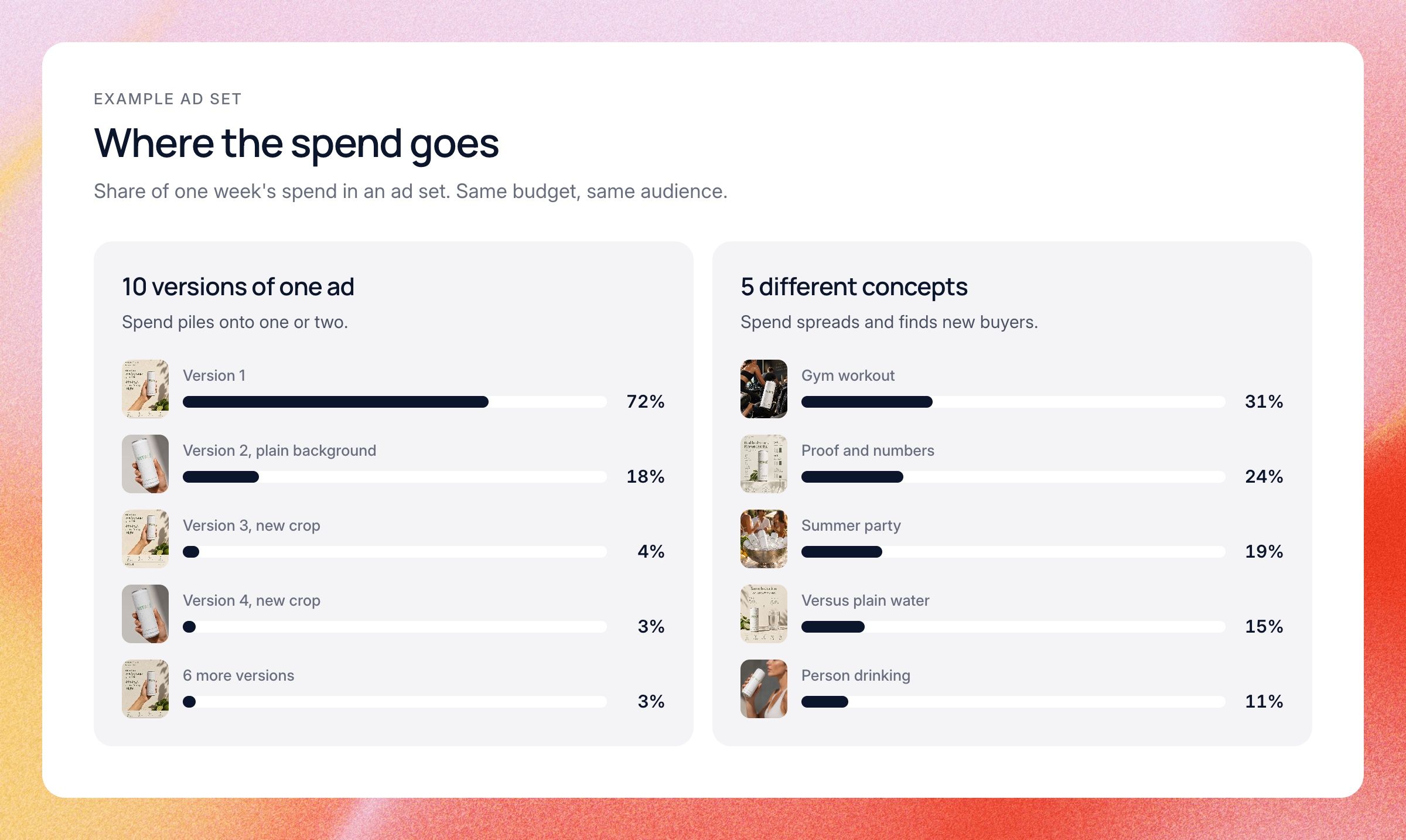
Many advertisers report a pattern that fits the idea. When an ad set is full of variations of one concept, spend piles onto one or two ads and the rest barely spend. When the ads are clearly different, spend spreads further and the account finds new groups of buyers.
What Andromeda didn't change
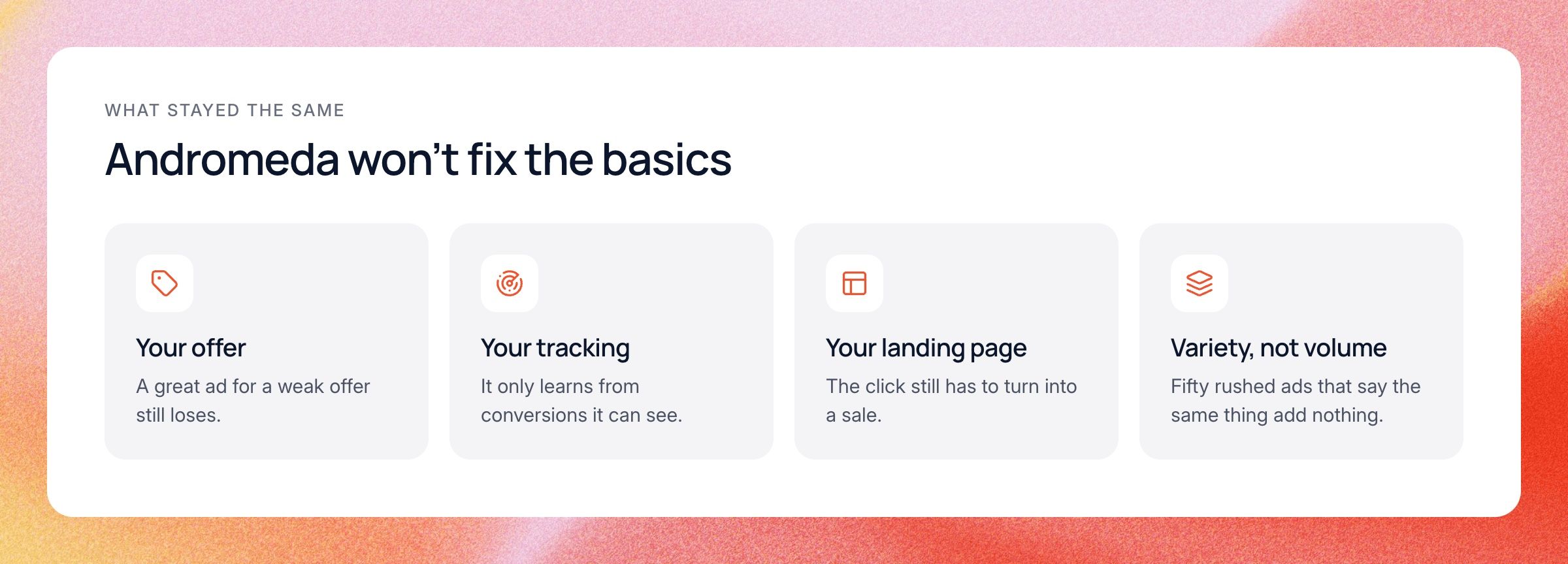
Some things stayed the same. Your offer still matters a lot. A great ad for a weak offer still loses, and a strong offer can carry plain creative a long way.
Tracking still matters too, because the system can only learn from the conversions it can see. And more ads isn't the same as more variety, so fifty rushed ads won't help if none of them say anything new.
Andromeda also won't fix a struggling account on its own. If your results dropped, check the ads, the offer, the landing page and the tracking before you blame the algorithm. Often the cause is something ordinary that you can fix.
What to do now: a Meta Andromeda checklist
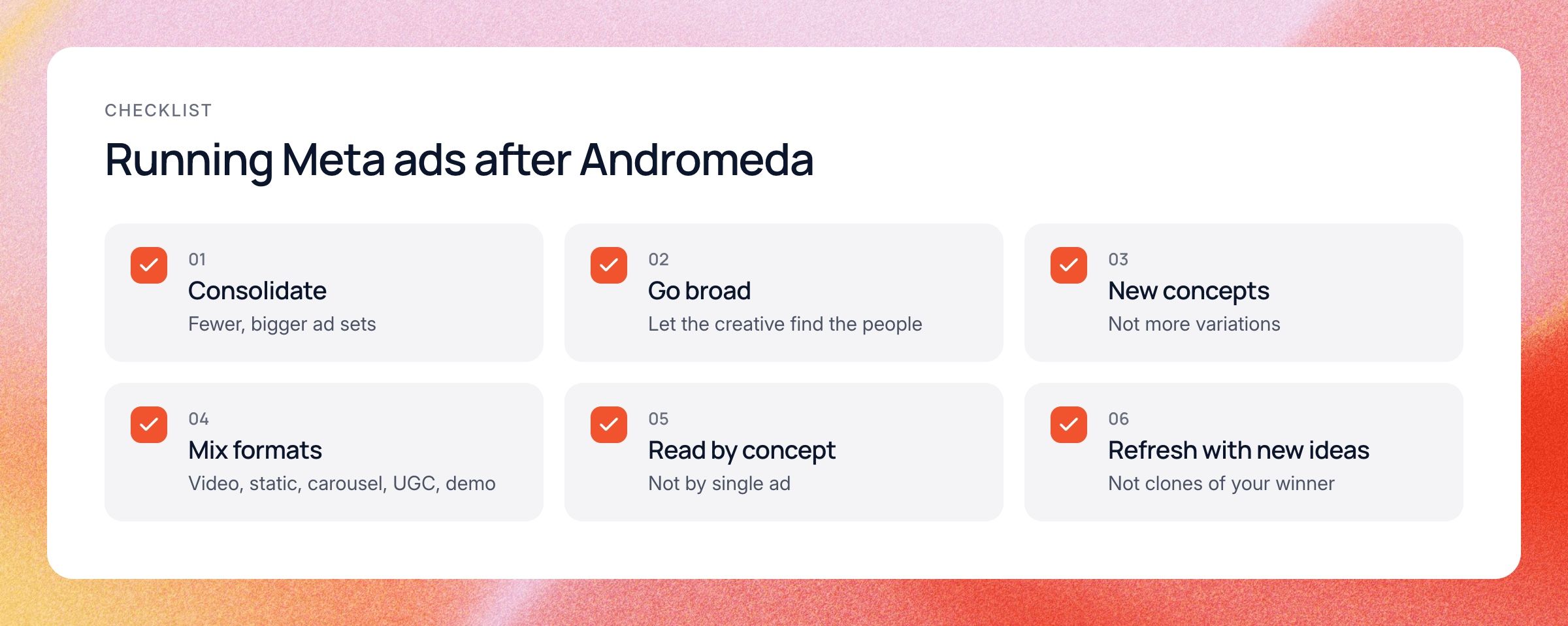
Here's the short version of how to run Meta ads after Andromeda. The three steps that trip most teams up get more detail below.
- Consolidate into fewer, bigger ad sets.
- Go broad on targeting and let the creative find the people.
- Build genuinely different concepts, not more variations.
- Mix formats on purpose: video, static, carousel, UGC, demo.
- Read results by concept, not by single ad.
- Refresh by adding new concepts, not by cloning your winner.
The steps are simple. What takes effort is changing habits, since most teams are used to testing small tweaks and slicing audiences, and both of those matter less now.
Fewer, bigger ad sets
Each ad set needs enough conversions to learn. When you split a budget across eight ad sets, each one learns slowly and they all compete for the same people. One campaign per goal, with one or a few broad ad sets, gives the system more data and more room to match each ad to the right person.
Keep a separate ad set only when something really differs. Good reasons are a different country, a different offer, or a budget you need to control on its own. "I want to test a new interest" is no longer a good reason.
Build genuinely different concepts
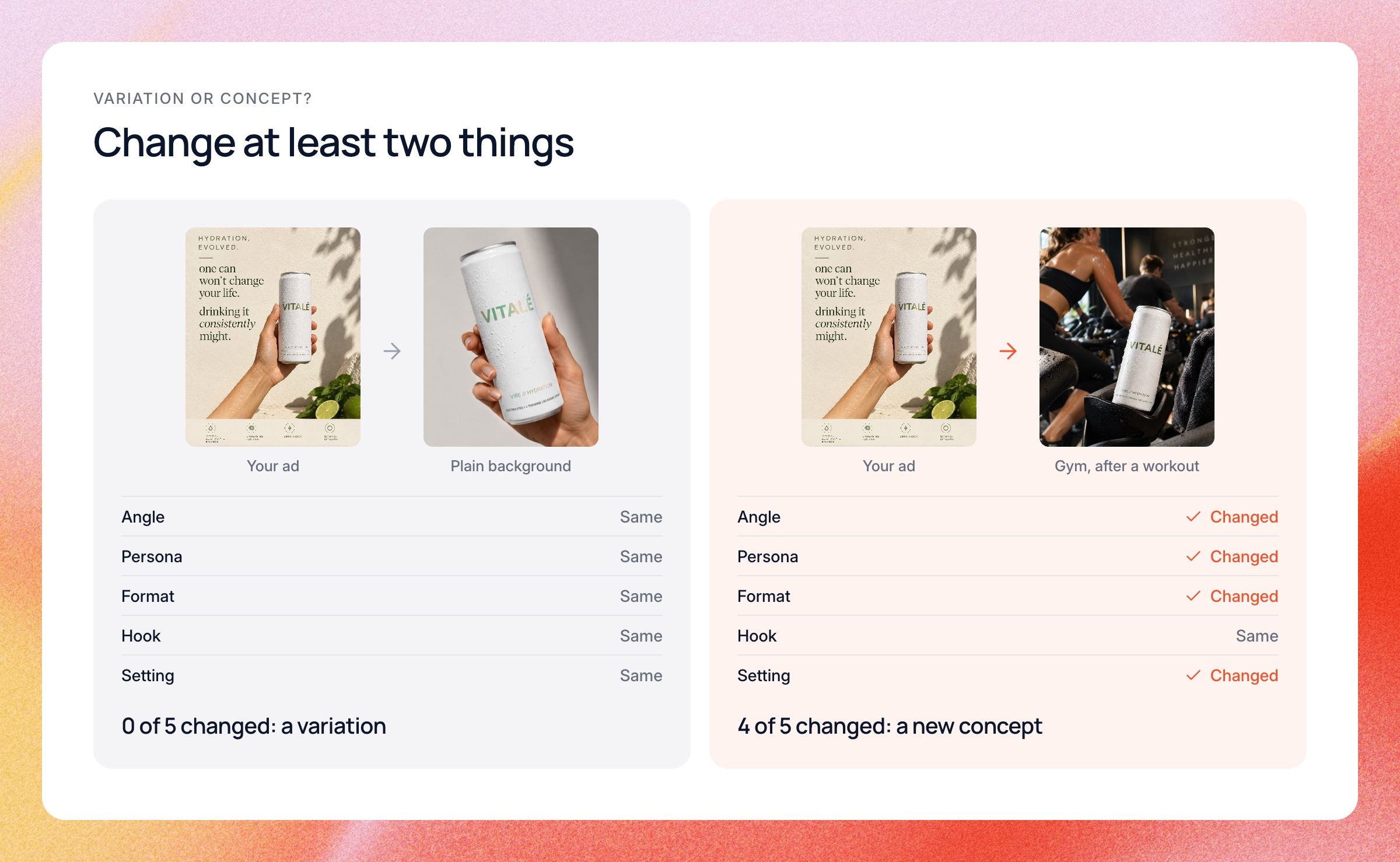
A concept is the core idea of an ad: who it's for, what problem it speaks to, and why they should care. A variation is the same idea with a new color, a new first line or a new crop. Different concepts give Andromeda more to work with than variations do. An ad becomes a new concept when you change things like these:
- Angle: the problem or desire it leads with (save time, save money, look better, avoid a risk)
- Persona: who it talks to, and who's on camera
- Format: UGC video, founder to camera, static image, carousel, product demo
- Hook: the first three seconds of a video, or the headline on a static
- Setting: where it's filmed and what the scene looks like
A simple rule: if one sentence describes two ads, they're the same concept. Change at least two of the things above and you have a real shot at something new. Start with a handful of strong concepts per ad set and keep adding new ones as the old ones tire.
Hooks deserve extra attention, because the first seconds decide whether anyone stays. Track your hook rate per concept so you know which openings stop the scroll. A new hook on a new angle is worth far more than a new hook on the same angle.
Read results by concept, not by ad
Ads Manager shows results per ad, and that's the wrong level now. If you run six versions of one concept, Meta may treat them as one, so looking at them one by one tells you very little. Group your ads by concept, then add up spend, results and cost per result for each group.
Naming makes this easy. Put the concept, angle and format in every ad name, for example "C07_price-worry_ugc_v2". Then you can group them in a sheet or a tool in seconds.
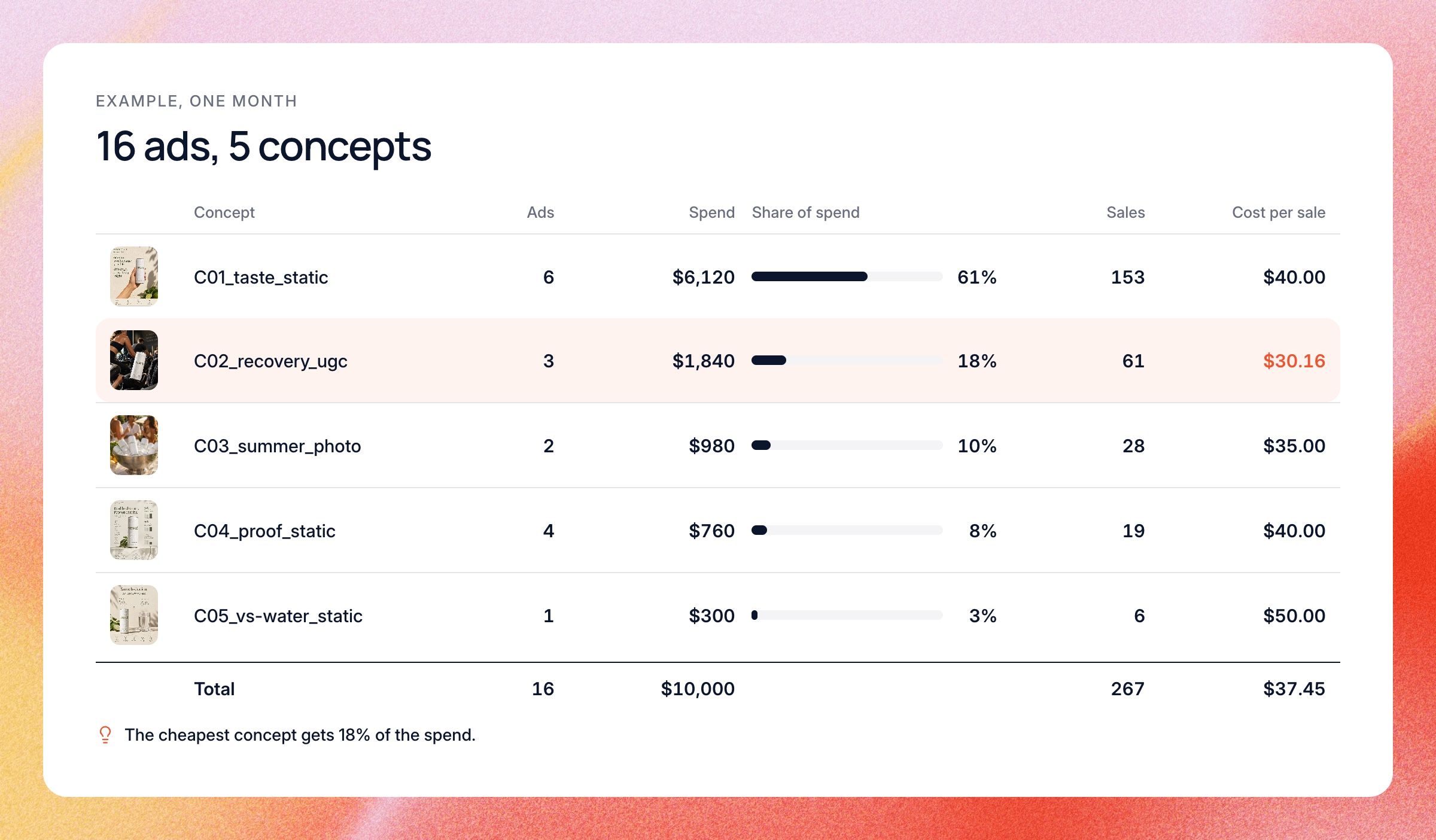
Then ask simple questions. How many concepts got meaningful spend this month? Is one concept taking most of the budget? Which concepts are new, and which ones have been running for three months? Those answers tell you what to brief next. If you want a structure for running those tests, start with our page on creative testing.
How to tell if your ads look "too similar" to Meta
Ads Manager doesn't show a similarity score, so you have to check this yourself. Look for these signs:
- A few ads take nearly all the spend in an ad set, and the rest get almost nothing for weeks.
- New ads launch and barely spend, even when you think they're good.
- Frequency keeps climbing while reach stays flat.
- Every ad opens with the same scene, the same person or the same first line.
- Your "tests" are mostly color, text or crop swaps of one winner.
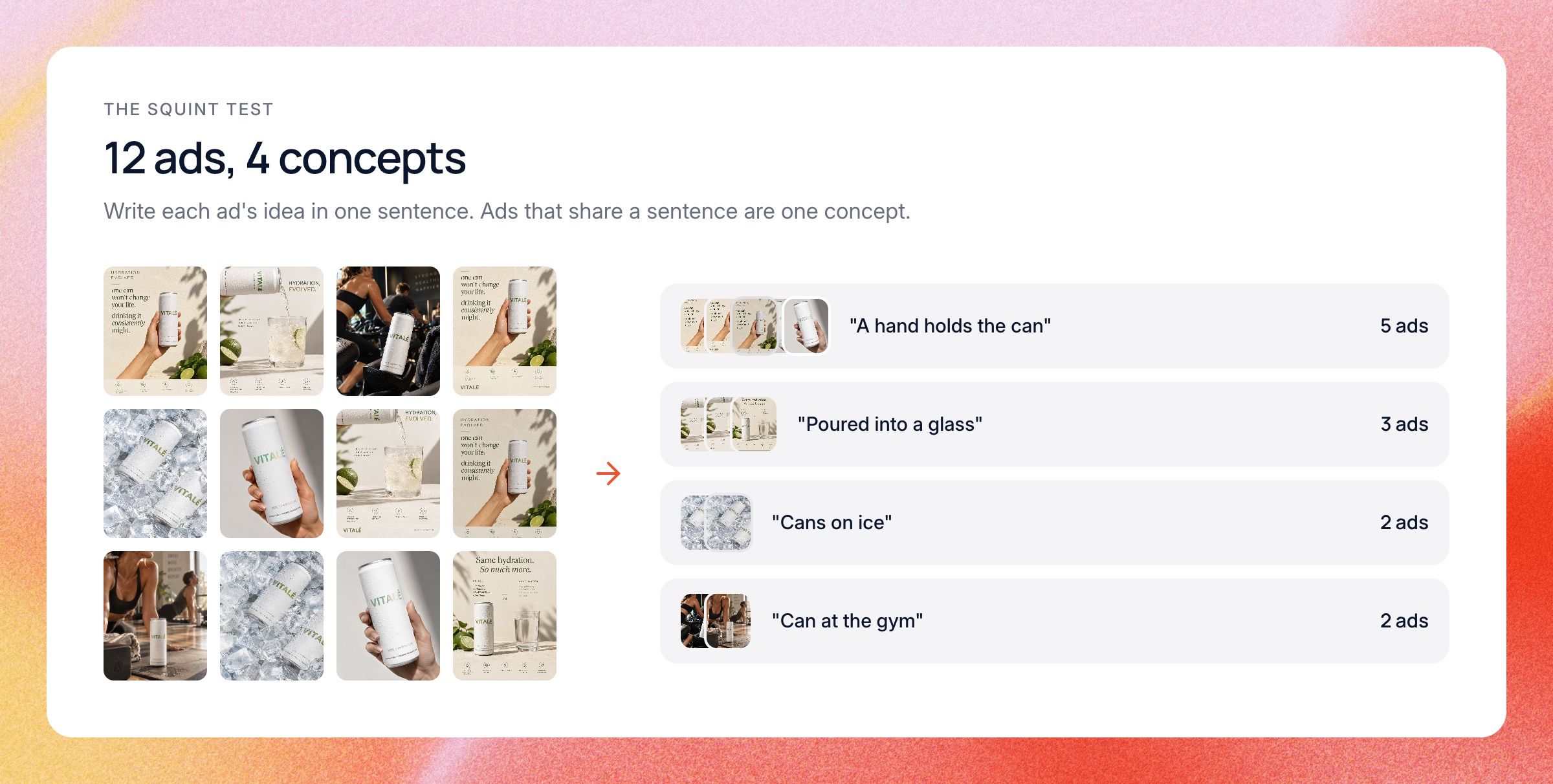
Try a squint test. Put the first frame of every live ad side by side, then read every first line out loud. If they blur together for you, they probably blur together for Meta too.
Then count. Write the core idea of each ad in one sentence and group the ads that share a sentence. If 30 ads collapse into four sentences, you have four concepts, not 30 ads.
Watch creative fatigue more closely
When one concept does all the work, it also wears out faster. The same people see the same idea again and again, and the results slide. That's creative fatigue. If Meta treats similar ads as one, fatigue can hit the whole concept at once instead of a single ad.
The fix is the same as above: have the next concept ready before the current one tires. Watch click-through rate and cost per result for each concept against its own first weeks, not against the account average. Our guide to ad fatigue walks through the exact signs and fixes.
It also helps to look outside your own account. Seeing which angles and formats others in your space are running is a fast way to find concepts you haven't tried. Our guide to competitor ads shows how to study them for ideas, not copies.
How this works in Lemonado
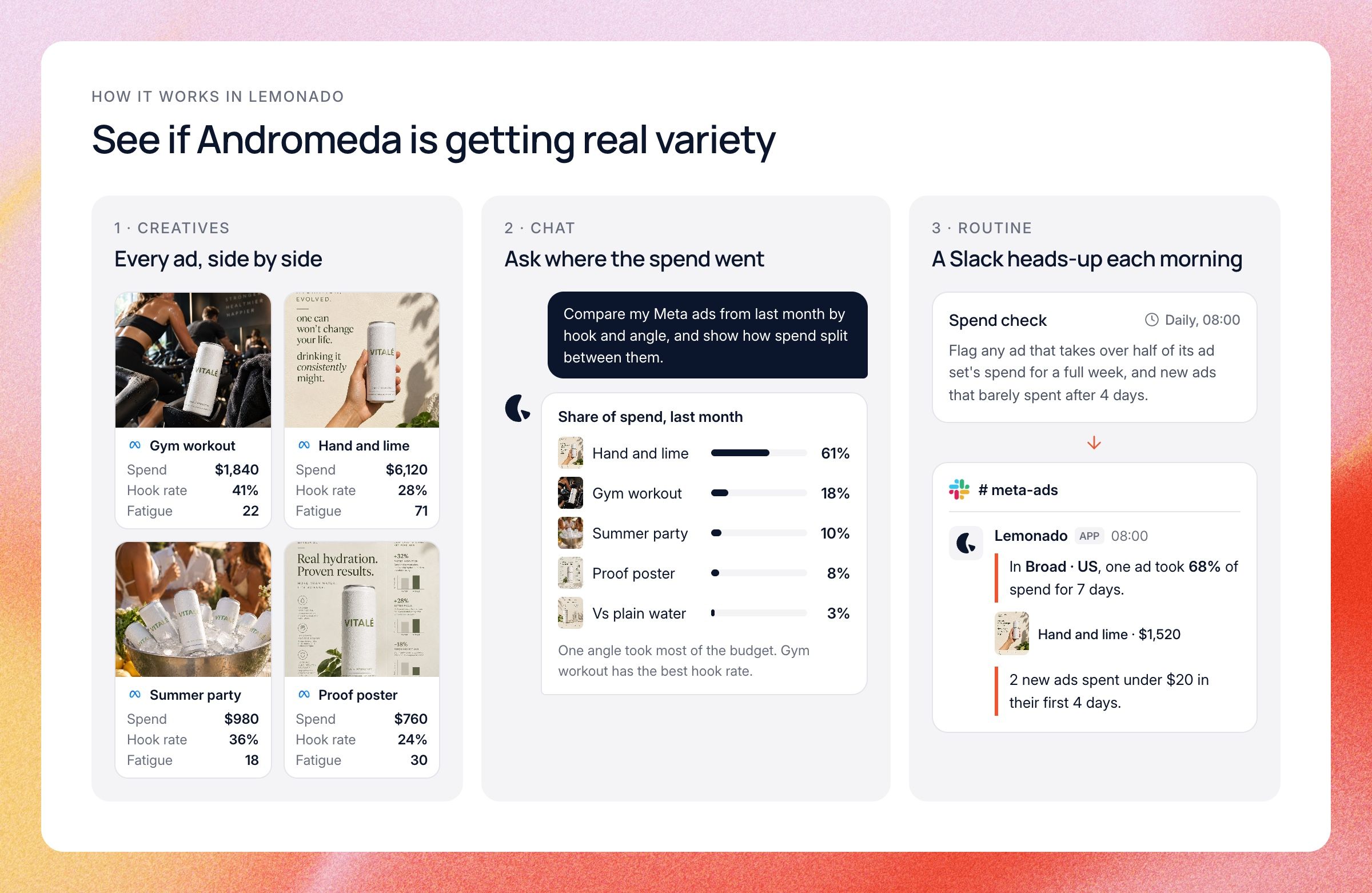
Lemonado's Creatives workspace puts every ad from your Meta account side by side (plus Google and YouTube, TikTok, LinkedIn, Pinterest and Snapchat) with its spend and results. Each ad gets a hook score, hook rate, hold and completion rates, and a fatigue score, so you can see which ads are carrying the account and which ones are starting to tire. Save the ones to watch in lists, like top performers or a fatigue watchlist.
To check whether you're feeding Andromeda real variety, ask in Chat. Try "Compare my Meta ads from last month by hook and angle, and show how spend split between them." Lemonado pulls up the creatives in the conversation, so you can ask why one wins and what the others have in common.
Then hand the watching off. A Routine can check your Meta account every morning and post to Slack when spend piles up, for example when one ad takes more than half the spend in its ad set for a full week, or when a new ad has barely spent after a few days. You write the rule in plain words, and it runs on your connected data. If you run Meta for several brands, the same Routine can cover every client account.
Do this with AI
You can run a first check today with ChatGPT or Claude. Export your live Meta ads with ad names, ad sets, primary text, headlines, spend and results. Add a short description of each video or image, because the AI can't see your creative unless you describe it.
Be honest in those descriptions. Note who's on camera, where it's filmed and what happens in the first scene. Run it once a month, or before you write new briefs, so you know which gaps to fill.
You are a senior Meta ads creative strategist. Below is an export of my live Meta ads for the last 30 days: ad name, ad set, primary text, headline, a short description of the visual and the first 3 seconds, spend, results and cost per result. 1. Group the ads into concepts. Two ads are the same concept if one sentence describes both (same angle, same persona, same core message). Give each concept a short name. 2. For each concept, show: number of ads, total spend, share of total spend, results and cost per result. 3. Flag any ad set where one concept takes more than 50% of the spend. 4. Flag ads that are only cosmetic variations (color, crop, text overlay, small copy change) of another ad. 5. Rate my creative variety from 1 to 5 across angle, persona, format and hook, and explain the score in two sentences. 6. Suggest 5 new concepts I'm missing, each with an angle, a persona, a format and a first line. Return a table, then a 5-line summary I can paste into Slack. Data: [paste your export here]
FAQs
These are the questions we hear most about Meta Andromeda. Most of them come back to giving the system real choices and reading results by concept. If your question isn't here, the checklist above is the best place to start.
What is Meta Andromeda?
Meta Andromeda is the AI system Meta uses for ad retrieval, the first step in choosing which ads someone sees. It narrows tens of millions of possible ads down to a few thousand for each person. Ranking models then pick the final ads for the auction. Meta introduced it in December 2024.
When did the Meta Andromeda update happen?
Meta announced Andromeda on its engineering blog on December 2, 2024, and said it was already deployed on Facebook and Instagram. Meta hasn't published one rollout date for advertisers, and its creative diversification guidance followed in April 2025. That's why "the Andromeda update" means different dates to different people, and why many advertisers say they felt the shift during 2025.
Is the Facebook Andromeda update the same thing?
Yes. "Facebook Andromeda update", "Andromeda Meta" and "Meta ads Andromeda update" all refer to the same system. Meta has deployed it on both Facebook and Instagram. People search for it under different names.
How many ads should I run per ad set now?
Meta hasn't published a magic number. What matters is how many different concepts you have, not how many ads. Twenty variations of one idea give the system fewer real choices than five distinct concepts. Start with a handful of clearly different concepts and add more as you learn what works.
What is an Entity ID in Meta ads?
"Entity ID" is a term media buyers use for the way Meta seems to group very similar ads and treat them as one. Meta hasn't documented it or published a similarity threshold. Treat it as a useful mental model: if ads look and sound alike, expect them to share one chance at the auction.
Is Andromeda why my Meta results changed?
It can be part of it, especially if your account was built on many small variations or many narrow ad sets. But offers, tracking, landing pages, seasonality and rising costs move results too. Check those first, then look at how many real concepts are getting spend.
Get started
Andromeda rewards accounts that give it real choices. The quickest way to see if yours does is to group your ads by concept and look at where the spend goes. Connect your Meta account to Lemonado, open Creatives to see spend, hook scores and fatigue for every ad, then ask it to compare them by angle. Get $150 in credits for up to 10 days, no card needed.