

Most bad ads start with a bad brief. The designer or creator did exactly what they were asked, and what they were asked was vague. "Make it pop" and "speak to millennials" don't tell anyone what to make.
This guide gives you a creative brief template built for ads and content, a filled-in example for a paid social ad, a short version for UGC creators, and the mistakes that waste the most budget. Copy the template, fill it in, and send it today.
What a creative brief is
A creative brief is a short document that tells the people making your ad or content what to make and why. It covers who the work is for, the one thing it should say, and how you'll know it worked. Think of it as the agreement between the person asking for the work and the person doing it.
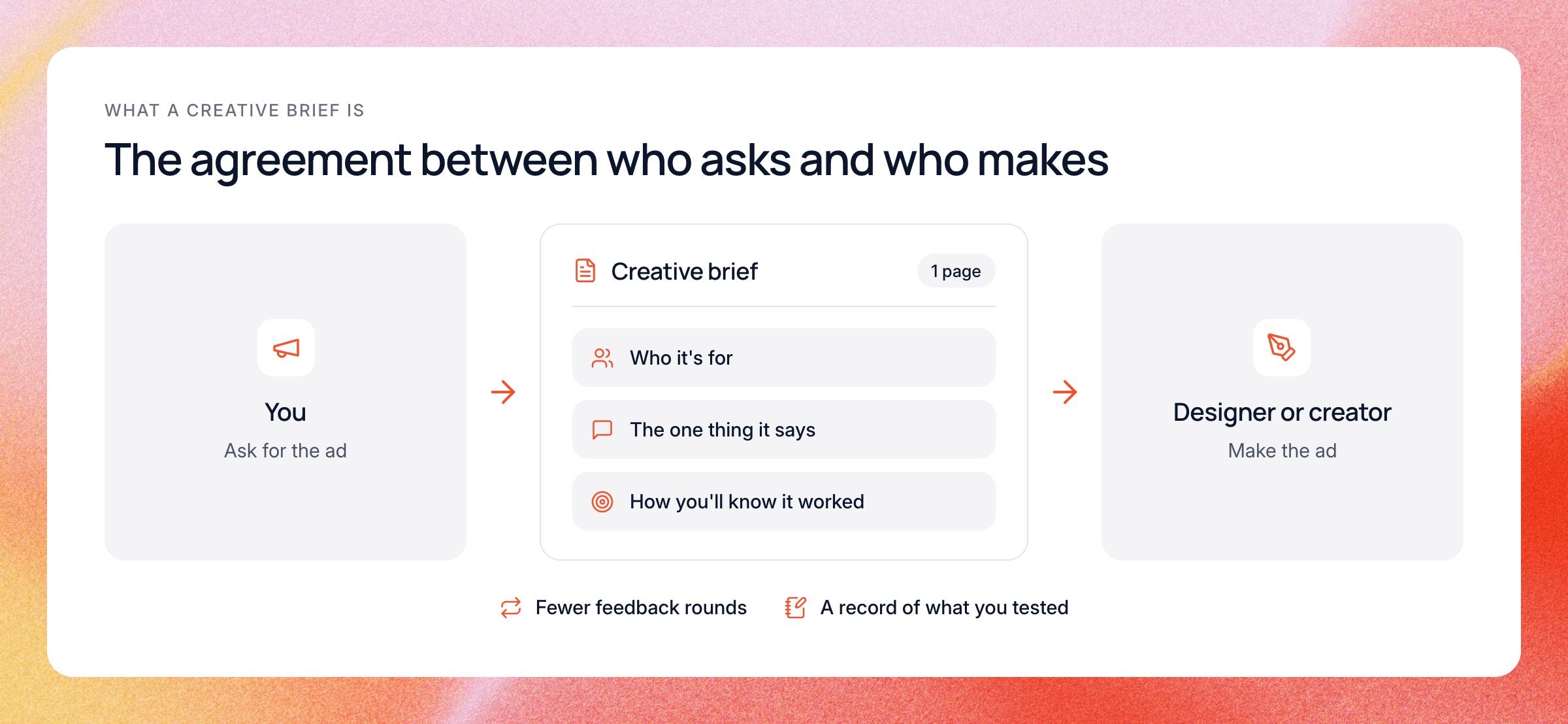
A good brief saves time on both sides. The creator spends less time guessing, and you spend less time on rounds of feedback. When the ad goes live, you also have a record of what you were testing, which makes the results easier to learn from.
For marketers running ads, the brief matters even more. You might ship dozens of new ads a month across Meta, TikTok and Google. A brief turns each one into a test you can read later, because you wrote down what you were trying before it went live.
What goes in a creative brief
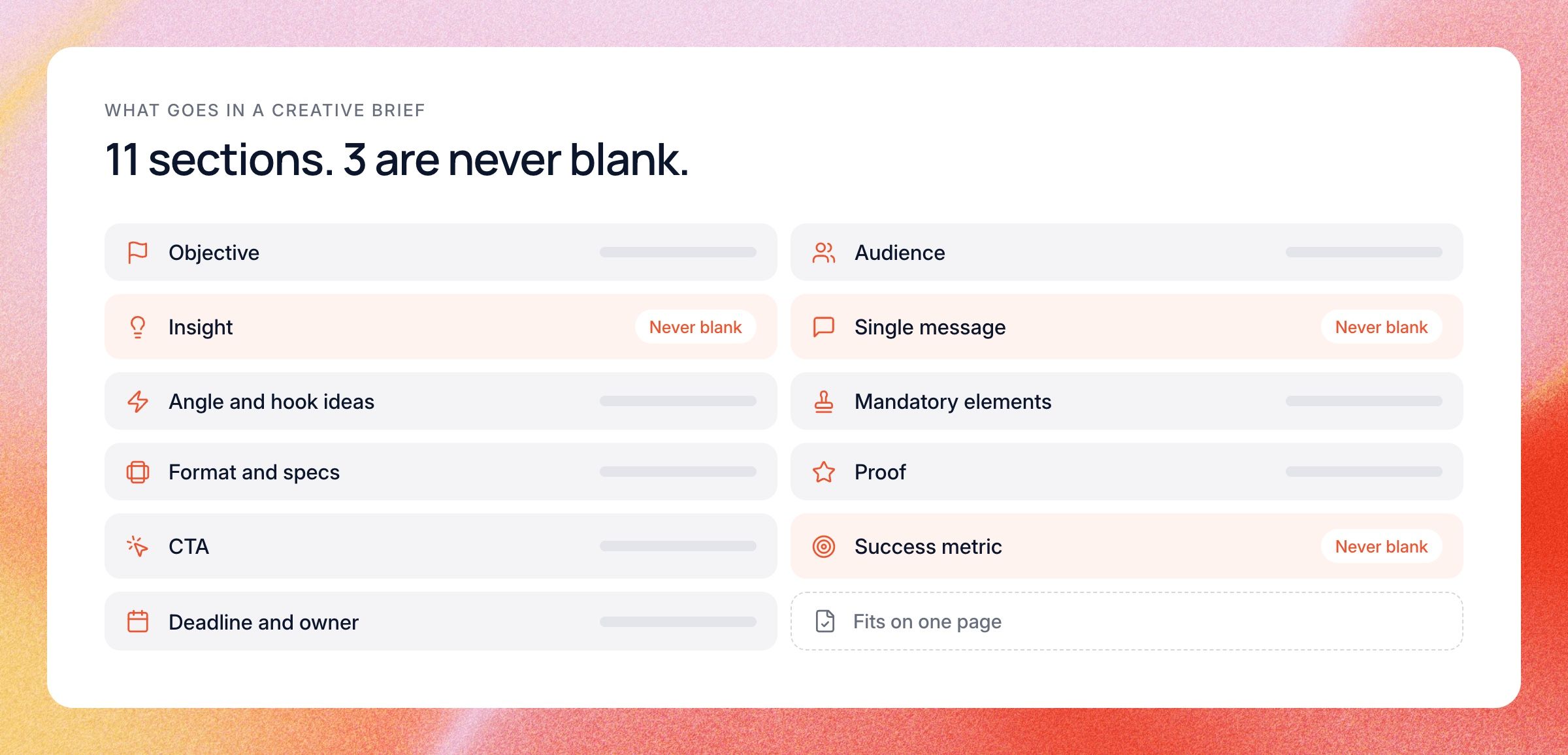
Every brief answers the same basic questions. These are the sections we use for ads and content:
- Objective: what this piece of work should make people do
- Audience: who it's for, in plain words
- Insight: the true thing about the audience that the idea is built on
- Single message: the one thing they should remember
- Angle and hook ideas: how you'll open and frame it
- Mandatory elements: what must be in it (logo, offer, legal lines)
- Format and specs: sizes, lengths and placements
- Proof: why they should believe you
- CTA: the action you want them to take next
- Success metric: the number that tells you it worked
- Deadline and owner: when it's due and who decides
You don't need every section for every job. A quick static ad might only need half of them filled in. But the insight, the single message and the success metric should never be blank. Those three are what make a brief useful instead of a form someone filled in for the sake of it.
The creative brief template (copy this)
Copy the block below into a doc, a Notion page or a Slack message. Replace the text after each colon with your own. Keep each answer to one or two lines, because if it takes a paragraph you probably haven't decided yet.
Project name: [Campaign or ad name, plus date] Objective: [What should this make people do? One action only. Example: start a free trial.] Audience: [Who they are, what they care about, and what they already know about you.] Insight: [The true, specific thing about this audience that the idea rests on. Where did it come from?] Single message: [One sentence the viewer should walk away with.] Angle and hook ideas: [2 to 4 ways to open the ad. Write the first line or first visual for each.] Mandatory elements: [Logo, offer, product shot, disclaimers, brand colors, words to avoid.] Format and specs: [Platforms, sizes (for example 9:16 and 4:5), lengths, number of versions.] Proof: [Reviews, numbers, demos, press, before and after. What makes the claim believable?] CTA: [The exact next step and the button or line you want.] Success metric: [The main number and the target. Example: hook rate above 30% and CPA under $40.] References: [Past winning ads, competitor ads or styles to look at. Links.] Deadline and owner: [Draft due date, final due date, who gives feedback, who approves.]
The whole template fits on one page, and that's on purpose. A brief that runs to five pages usually gets skimmed, and the important parts get lost in the middle.
How to fill in each section
Copying the template takes a minute. Filling it in well takes more thought, so here is what a good answer looks like for each section.
Objective and success metric
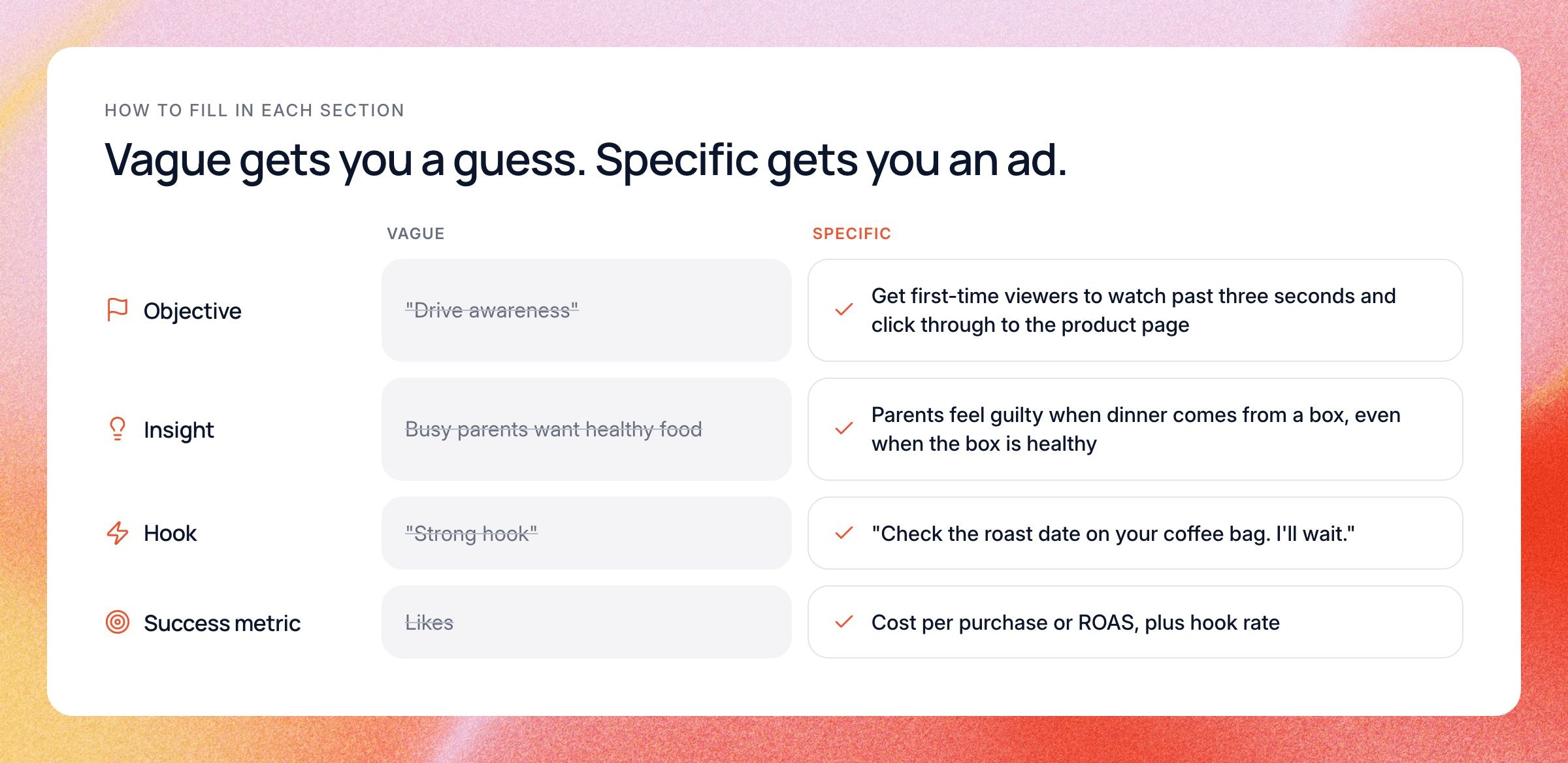
Start with the action, then pick the number that measures it. "Drive awareness" is too loose. "Get first-time viewers to watch past three seconds and click through to the product page" gives the creator something to design for.
Write these two together, because they keep each other honest. If the objective is sales, the success metric should be cost per purchase or ROAS, not likes. For ads, it often helps to add a creative metric too, like hook rate, so you can tell whether the opening worked even if the offer didn't.
Audience and insight
Describe the audience the way you'd describe a friend. Say what they want, what annoys them, and what they've already tried. Age ranges and job titles alone don't help anyone write a better first line.
The insight is the most important line in the brief. It's a true, specific thing about the audience that makes the idea land. "Busy parents want healthy food" is a fact everyone knows. "Parents feel guilty when dinner comes from a box, even when the box is healthy" is an insight you can build an ad around.
Good insights come from evidence. Read reviews, support tickets and sales call notes. Look at which of your past ads won and why. Look at what competitors keep running, and what angles they all skip.
Single message and angle
The single message is one sentence. If you can't say it in one sentence, the ad will try to say three things and land none of them. Everything else in the brief exists to support this line.
The angle is how you frame that message. The same message can be told as a problem and fix, a before and after, a founder story, a customer testimonial or a price comparison. Listing two or three angles in the brief gives the creator room to play while keeping them on message.
Hook ideas
For video ads, the first few seconds decide whether people keep watching. Write the hook lines themselves in the brief, not just "strong hook." Include the first visual too, since a lot of people scroll with the sound off.
Give two to four options and ask for a version of each. That turns one ad into a small creative test. When the results come in, you'll know which opening worked, and the next brief gets better.
Mandatory elements, format, proof and CTA
These are the practical parts, and leaving them out causes the most rework. List every must-have up front: the offer, the logo, any legal copy and any words the brand never uses. List formats too, since a 9:16 video and a 4:5 feed ad need different framing from the start.
Proof is what makes the message believable. Pick one or two strong pieces, like a review, a number or a quick demo, rather than piling on five. The CTA should match the objective exactly, and it should be the same action the landing page asks for.
Deadline and owner
Every brief needs a date and a decision-maker. Put the draft date and the final date in, and name the one person who approves. When three people can approve, nobody does, and the ad sits in review for a week.
Creative brief example: a paid social ad
Here's the template filled in for a paid social campaign. The brand is made up for this example, so you can see how each section reads when it's done properly.
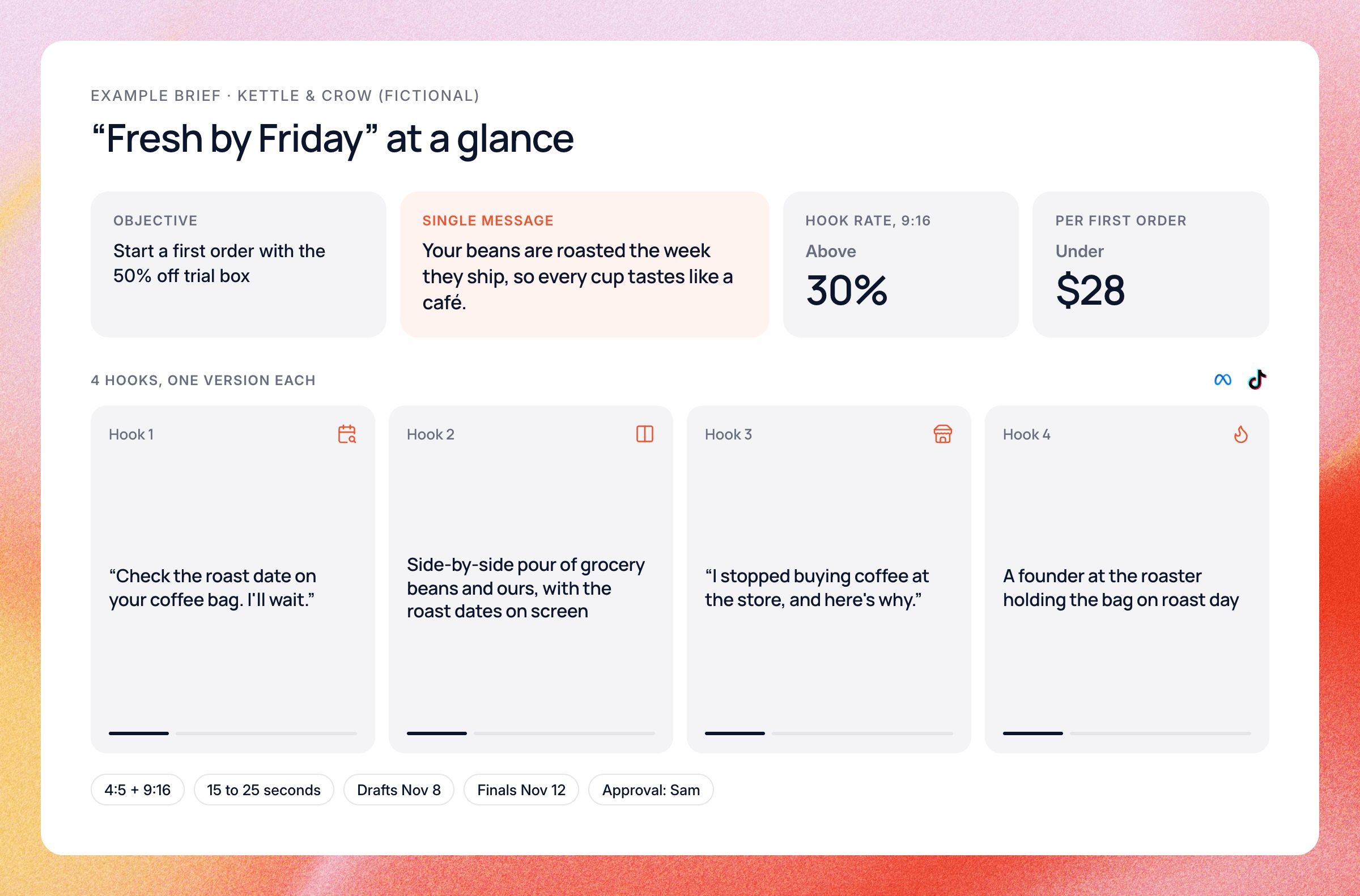
Project name: Kettle & Crow (fictional coffee subscription), "Fresh by Friday" Meta and TikTok ads, November Objective: Get new visitors to start a first order with the 50% off trial box. Audience: Home coffee drinkers, 25 to 45, who buy beans at the grocery store and have thought about a subscription but worry about being locked in. Insight: Grocery beans are often roasted weeks before they hit the shelf, and our buyers don't know that. When they find out, they feel a bit cheated. Single message: Your beans are roasted the week they ship, so every cup tastes like a café. Angle and hook ideas: (1) "Check the roast date on your coffee bag. I'll wait." (2) Side-by-side pour of grocery beans and ours, with the roast dates on screen. (3) "I stopped buying coffee at the store, and here's why." (4) A founder at the roaster holding the bag on roast day. Mandatory elements: Logo in the last 3 seconds. Offer "50% off your first box." Line "Skip or cancel anytime." No claims about health. Format and specs: Meta feed 4:5 and Reels or TikTok 9:16. 15 to 25 seconds. Captions burned in. One version per hook, four in total. Proof: 4.8 star average from reviews. Roast date printed on every bag. Real customer quote: "I can actually taste the difference." CTA: "Get your first box" button to the trial landing page. Success metric: Hook rate above 30% on 9:16. Cost per first order under $28 after 7 days. References: Our top two ads from last quarter (roast-date close-up and the founder video). Three competitor ads that open with a taste test. Deadline and owner: Drafts due Nov 8, finals due Nov 12. Feedback and approval: Sam, paid social lead.
Notice how specific each line is. The creator knows the exact opening lines to test, what must be on screen, and what number decides the winner. When the results come in, the team can see which hook pulled the best hook rate and brief the next round from that.
UGC creator brief: the short version
Creators need less strategy and more clarity. A long brief often reads like a script, and scripted UGC looks like an ad, which is the opposite of the point. Keep it short and give them room to sound like themselves.
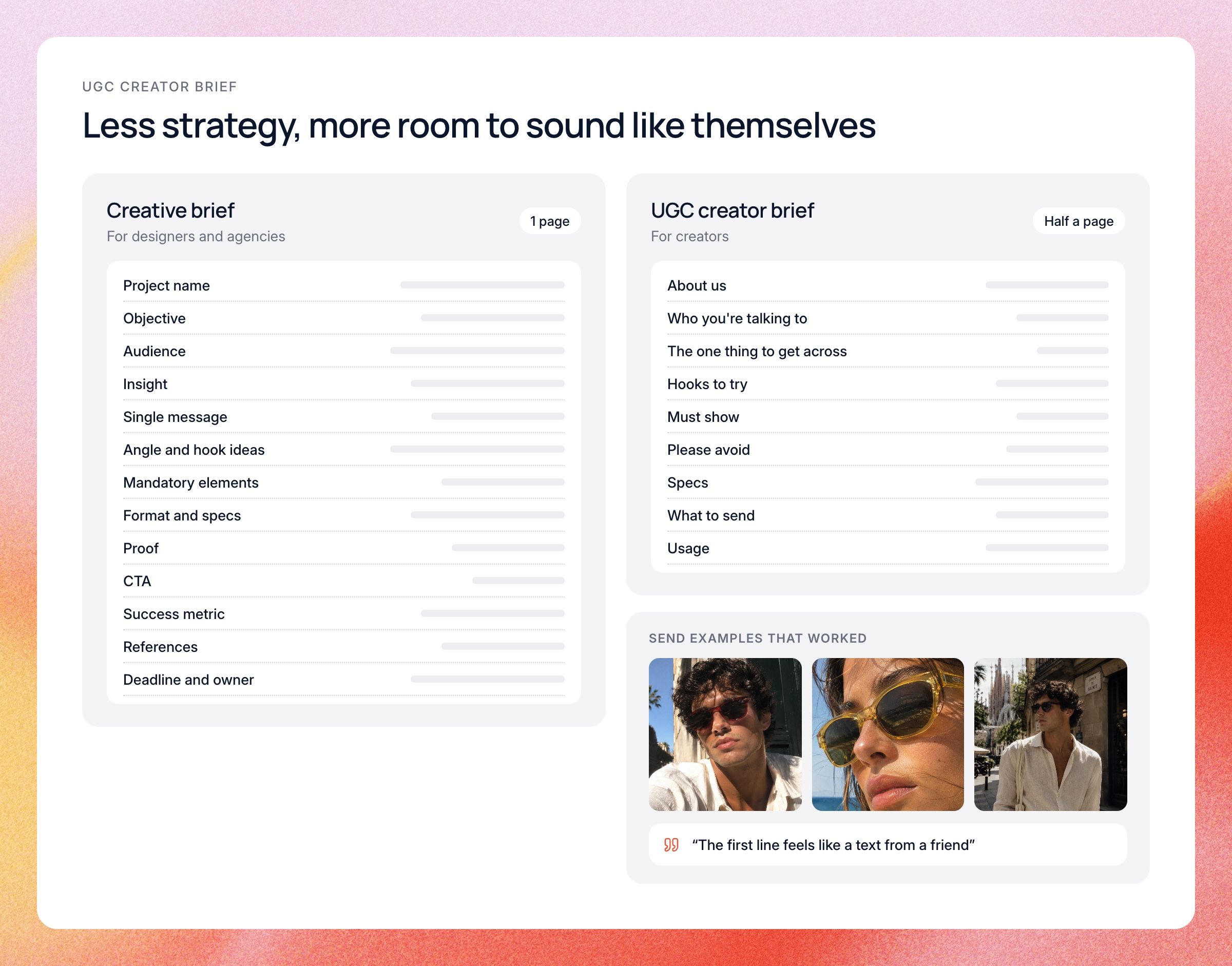
About us: One line on the brand and product. Who you're talking to: One line on the viewer and their problem. The one thing to get across: The single message, in plain words. Hooks to try: 2 to 3 opening lines. Film one take of each. Must show: The product in hand in the first 5 seconds, and the offer. Please avoid: Words, claims or competitor names to stay away from. Specs: 9:16, 20 to 40 seconds, natural light, no music (we add it). What to send: Raw clips plus one edited cut. File naming. Due date. Usage: Where and how long we'll run the ads.
Send real examples of UGC ads that worked for you, and say what you liked about each one. "The first line feels like a text from a friend" is more useful than "authentic vibe." If you've run creators before, share which hooks won so new creators start from what works.
Common creative brief mistakes
Most briefs fail in the same few ways. Here are the ones that cost the most:
- Trying to say three things in one ad
- An insight that's a fact everyone already knows
- "Strong hook" instead of written-out hook lines
- No success metric, so nobody knows if it worked
- Specs added after the shoot
- Too many people approving
- Briefs written from opinion instead of results
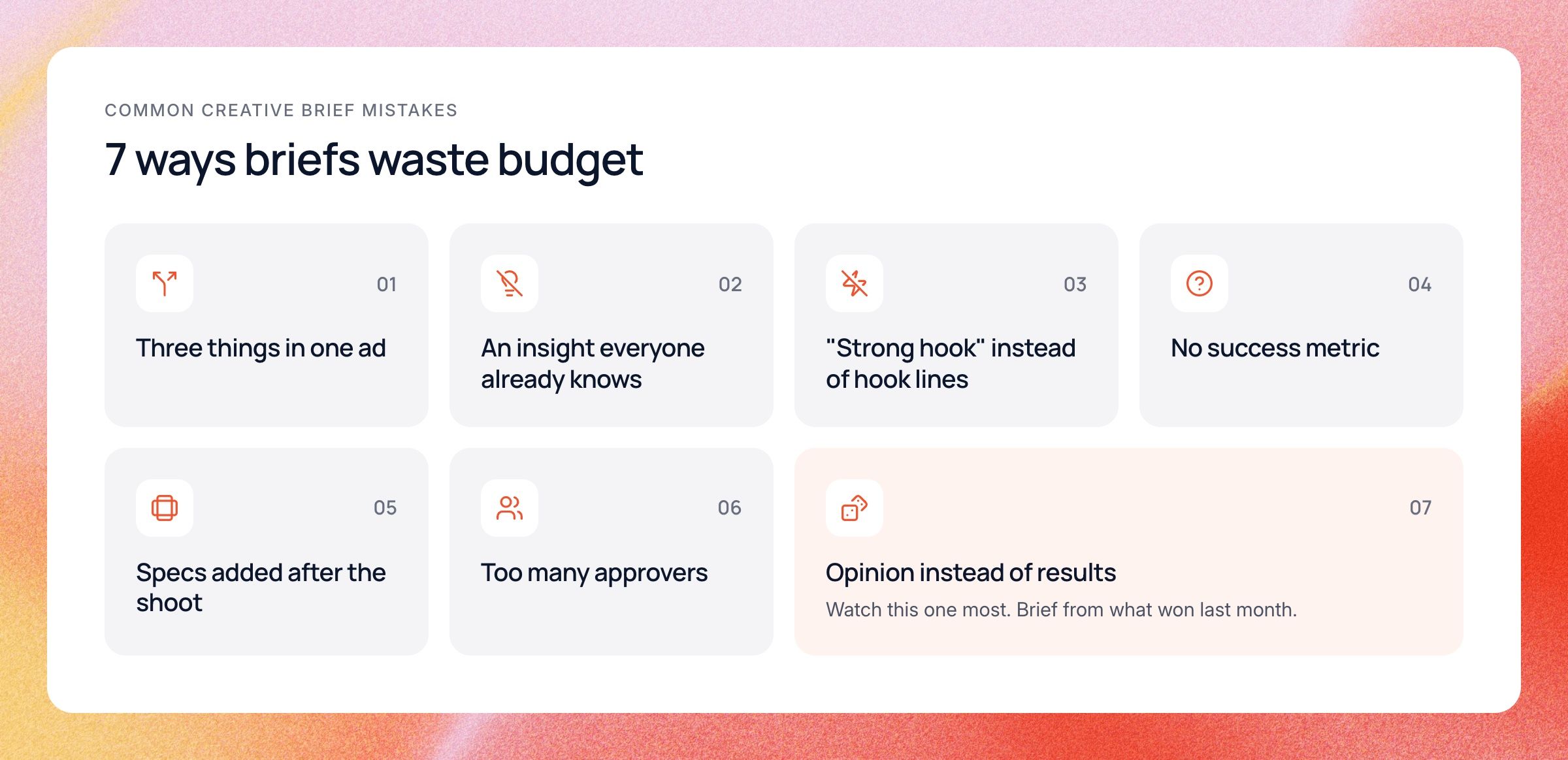
Watch the last one most. A brief built on "I think people will like this" starts from zero every time. A brief built on what won in your account last month starts from a proven base, and each round of ads teaches you something for the next.
Watch out for briefs that never change, too. If you're using the same angle for months, your audience has probably seen it enough. Check your creative fatigue signals and use the brief to push into a new angle before results drop. Our guide to ad fatigue shows how to tell when that's happening.
Do this with AI: turn research and winning ads into a brief
AI is good at the slow part of briefing, which is reading through a pile of research and past results and pulling out the pattern. You stay in charge of the insight and the final call. The AI does the first draft so you're editing instead of staring at a blank page.
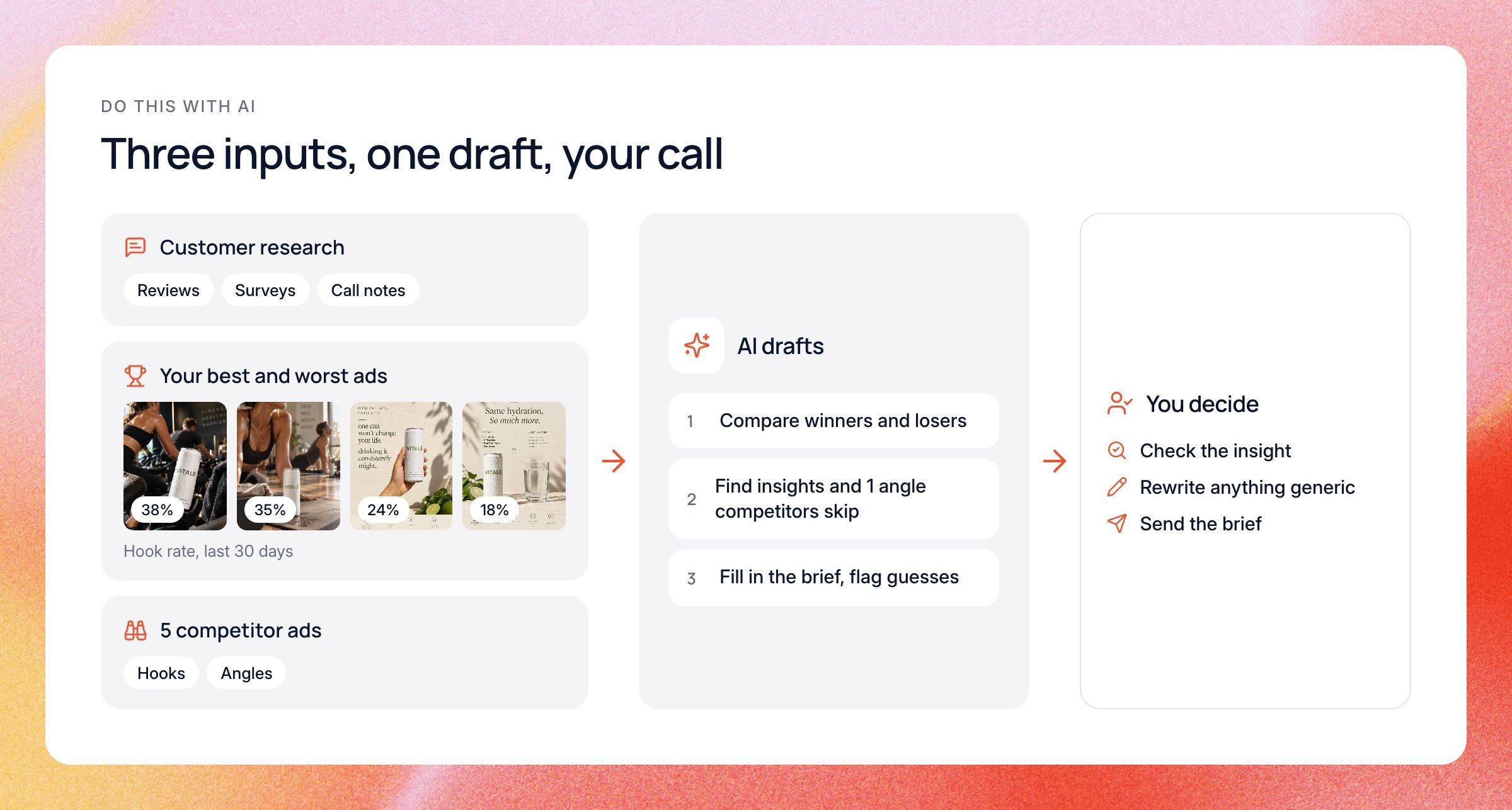
Give it three things: your research (reviews, survey answers, call notes), your best and worst ads with their results, and a few competitor ads. Then paste a prompt like this one:
You are a senior creative strategist writing a brief for paid social ads. Here is what I'm giving you: (1) customer research, (2) our top 5 and bottom 5 ads from the last 30 days with spend, hook rate, CTR and cost per result, (3) 5 competitor ads with notes on their hooks and angles. Step 1: Compare our winners and losers. List the hooks, angles, formats and proof types that show up more in winners. Only use what the data supports. Step 2: Find 2 or 3 insights in the research that our winning ads already touch on, and 1 angle competitors are not using. Step 3: Fill in this brief: objective, audience, insight, single message, 4 hook ideas (write the first line and the first visual), mandatory elements, format and specs, proof, CTA, success metric with a target based on our current numbers, references. Keep each field to one or two lines. Flag anything you are guessing.
Keep that last line in the prompt. AI will fill gaps with confident guesses, and a brief built on a guess can send a whole shoot in the wrong direction. Read every line, check the insight against the source, and rewrite anything that sounds generic.
How this works in Lemonado
The hardest part of the template is the insight, and the insight should come from data. Lemonado is an AI co-worker for marketing that connects to your ad accounts and does the analysis that usually takes an afternoon of exports.
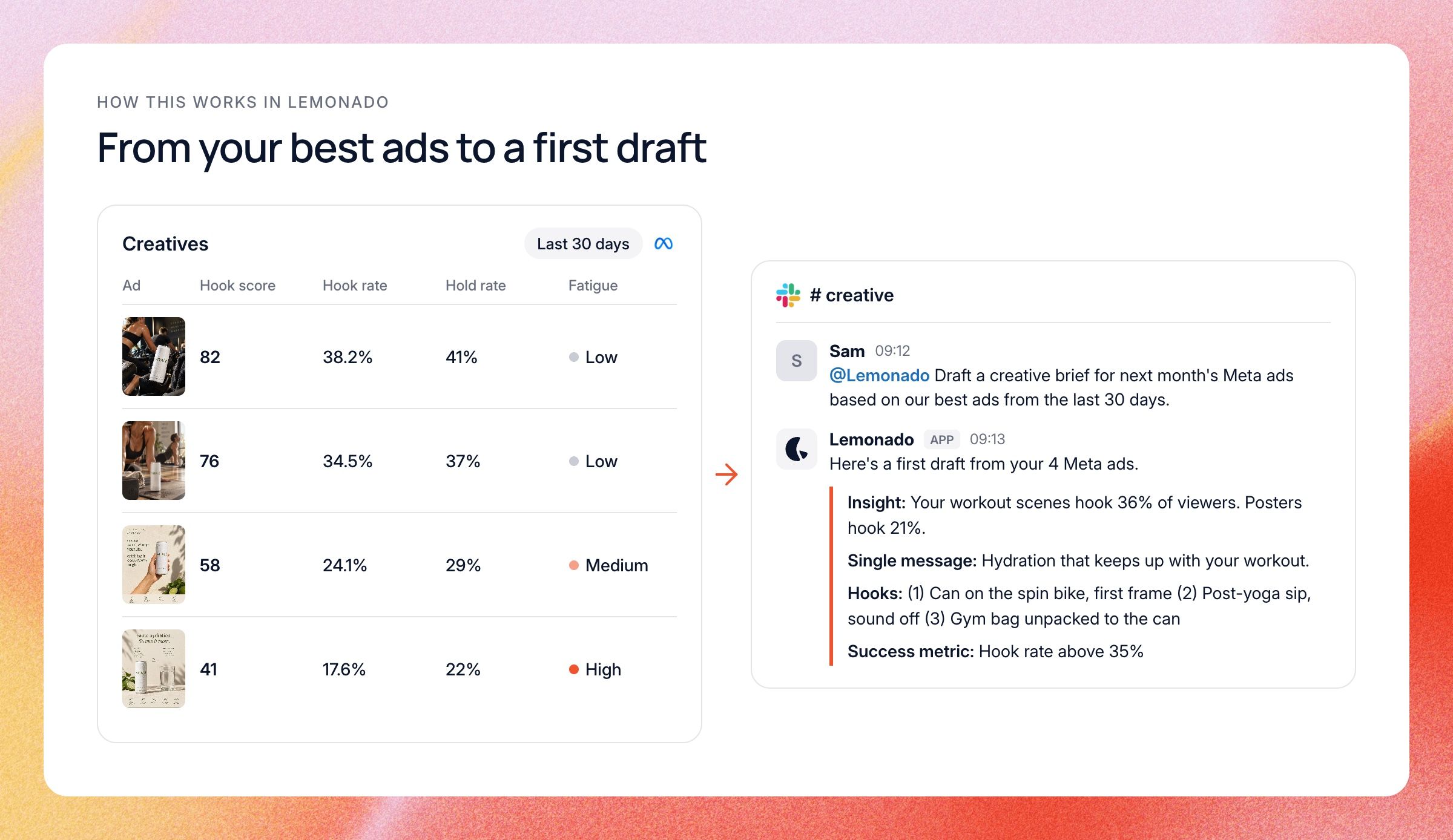
In Creatives, you see how each of your ads performs, with hook score, hook rate, hold rate and fatigue scores across Meta, Google (including YouTube), TikTok, LinkedIn, Pinterest and Snapchat. You can ask Lemonado to compare your ads by hook or angle and explain why one wins. In Discover, you browse competitors' ads, and Lemonado reads the why across them: their hooks, angles, offers, who's on camera and the landing pages they send people to. Save what you find to the team as reports to brief from. Discover works in the free trial, before you connect any data. For a deeper look at reading rival ads, see our guide to competitor ads.
Then you can ask Lemonado to draft the brief. In Chat or in Slack, try: "Draft a creative brief for next month's Meta ads based on our best ads from the last 30 days." It pulls your results, finds the patterns and writes a first draft in the template above. You and your team still finish the brief and make the ads.
Lemonado also remembers your team's goals and what has worked before, so later briefs can build on earlier rounds. For agencies running briefs across many clients, the agency setup keeps each client's history separate.
FAQs
These are the questions marketers ask most about creative briefs. Most of them come down to the same idea. Keep the brief short, specific and tied to a number.
What is the format of a creative brief?
A creative brief is usually a one-page document with labeled sections. The common sections are objective, audience, insight, single message, mandatory elements, format, proof, CTA, success metric and deadline. It can live in a doc, a Notion page or a project tool, as long as everyone works from the same version.
What are the main parts of a creative brief?
The main parts are the objective, the audience, the insight, the single message and the success metric. Those five tell the creator what to make and tell you how to judge it. The practical parts, like specs, mandatory elements and deadlines, keep the project on track.
How long should a creative brief be?
One page is the goal for most ads and content. If it runs longer, the main points get buried and people skim. A UGC creator brief can be even shorter, often under half a page.
What is the difference between a creative brief and a design brief?
A creative brief sets the strategy: who it's for, what it should say and why. A design brief is narrower and focuses on the look, like colors, fonts, layout and file types. For ads, most teams combine them into one document so the designer sees the strategy and the specs together.
Who should write the creative brief?
The person who owns the result should write it. On most marketing teams that's the campaign or channel owner, like the paid social lead. The creative team should review it before work starts so they can flag anything unclear.
Write your next brief from data
A creative brief is only as good as the insight inside it. Use the template, fill in every line with something specific, and base the insight on what has worked in your account. Then let each round of results shape the next brief.
Get $150 in credits, no card needed, and ask Lemonado to draft a brief from your best ads.