

For most ad accounts, the hardest question each week is what to make next. Creative strategy is how you answer that question with evidence instead of gut feel.
This guide covers what creative strategy means, the loop paid social teams run every week, where to find customer insight, and the difference between angles, hooks and formats. You'll also get a template you can copy, three brand examples, and a plain look at what a creative strategist does.
What is creative strategy?
Creative strategy is the plan for what your ads say, who they speak to and how they look, based on what you know about your customer. It sits between the business goal ("sell more of this") and the finished ad. A good one tells your designers, editors and creators exactly what to make and why it should work.
The term means two slightly different things depending on who you ask. In brand advertising, creative strategy is the big idea behind a campaign: one message and one tone, carried across TV, billboards and social for months or years. In performance marketing and paid social, creative strategy is a repeating system. You research, write briefs, ship lots of ads, read the results, and use what you learned to plan the next batch.
Both versions start in the same place: a clear insight about the customer. This guide focuses on the paid social version, because that's where most marketers spend their week. The brand version still matters, and the best performance teams use it as the guardrail for everything they test.
Creative strategy in advertising: why it matters more now
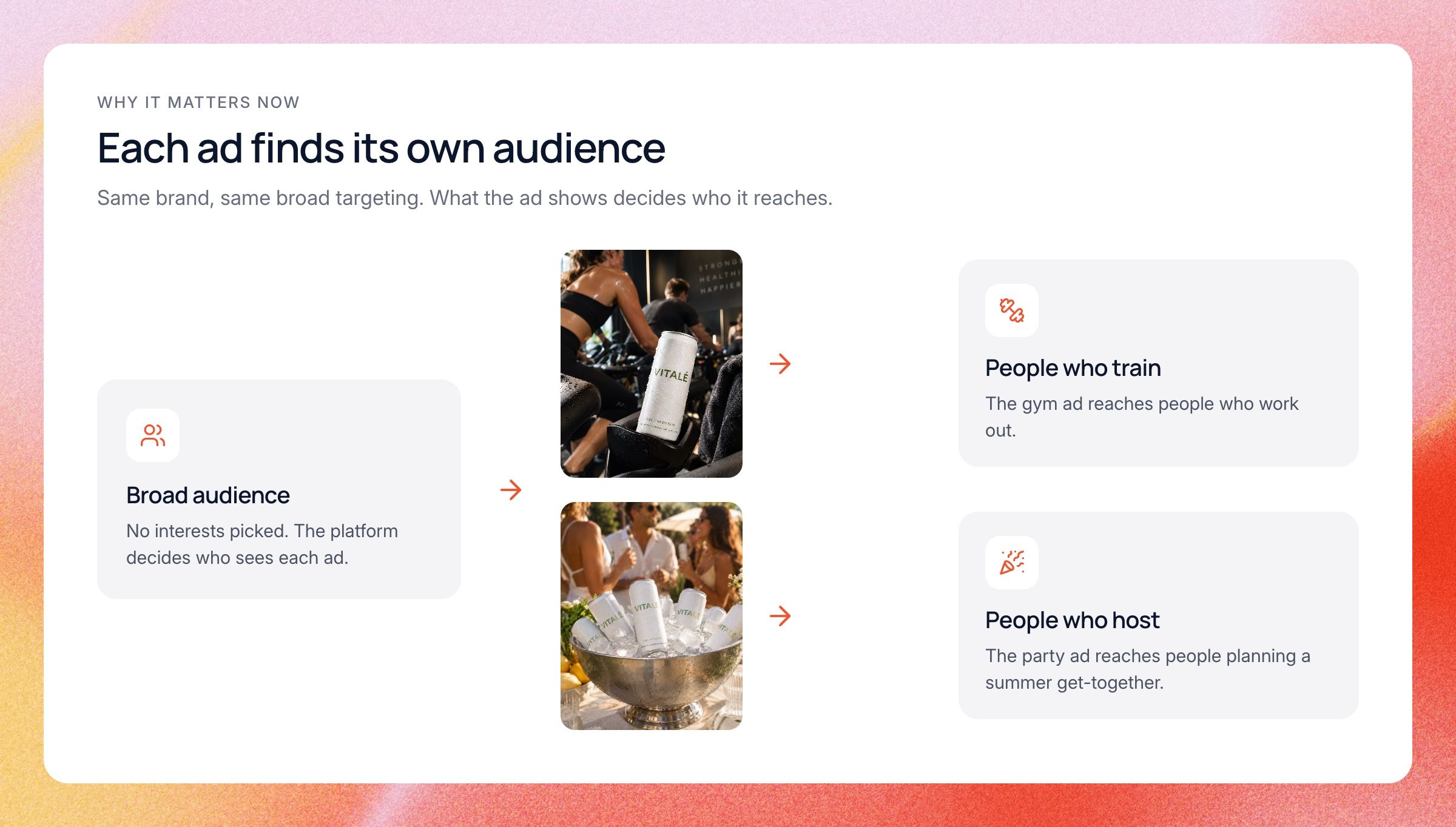
On Meta and TikTok, most targeting has moved to the algorithm. Broad audiences and automated campaigns mean the platform decides who sees your ad. That leaves the creative as the main thing you still control.
Each ad works like its own targeting. A video about joint pain finds people with joint pain. A video about saving time on dinner finds busy parents. So your creative strategy is also your targeting strategy.
It matters for another reason too. Even a winning ad fades as the same people see it again and again (we cover the warning signs in our guide to ad fatigue). Without a system for what comes next, teams end up guessing under pressure.
The creative strategy loop
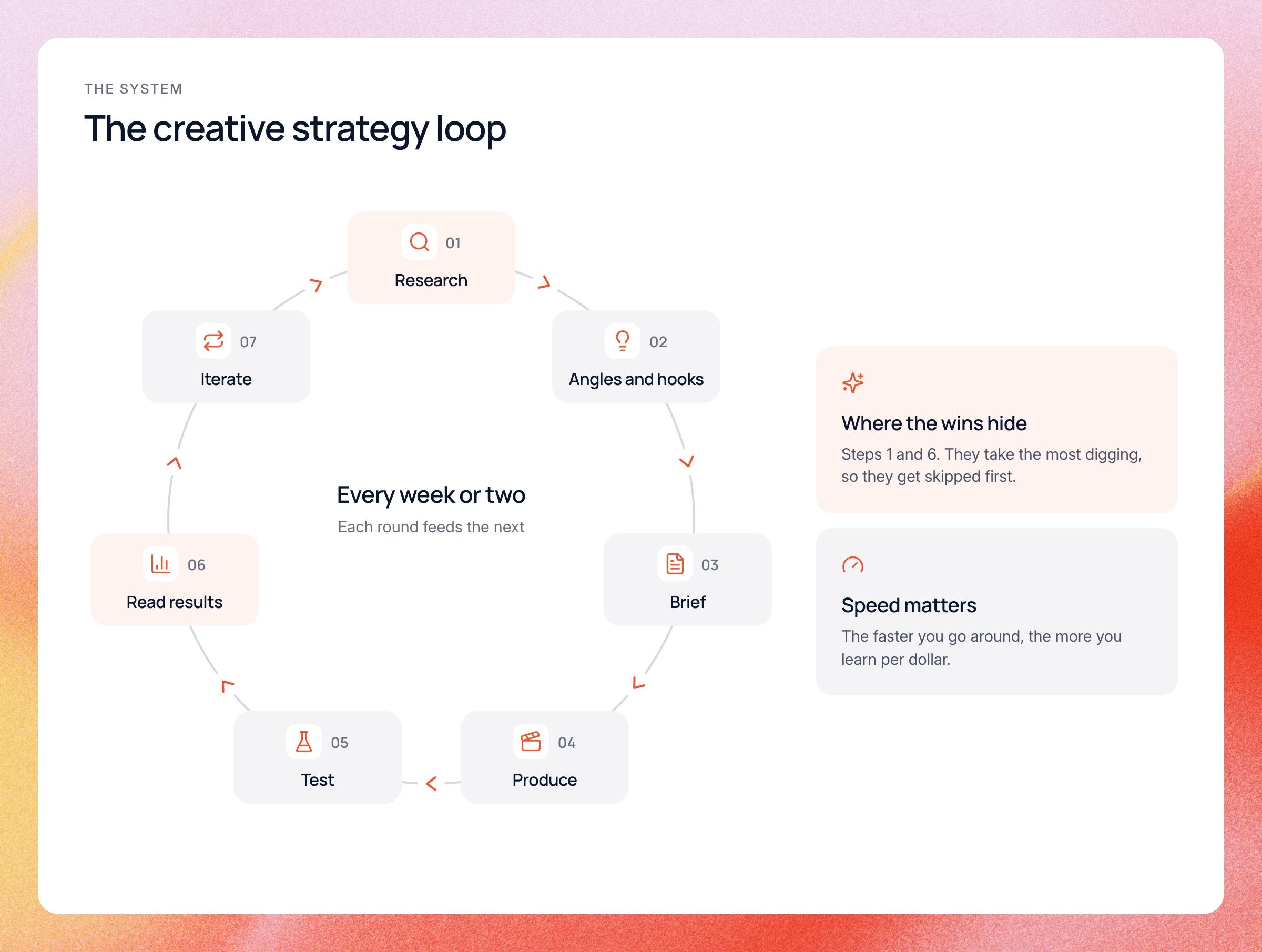
Paid social creative strategy runs as a loop. Each round teaches you something you feed into the next one. Here are the seven steps:
- Research
- Angles and hooks
- Brief
- Produce
- Test
- Read results
- Iterate
Most teams are decent at steps 3 and 4. The big wins usually hide in steps 1 and 6, because they take the most digging and get skipped when the week gets busy. The faster you get around the loop, the more you learn for every dollar you spend.
1. Research
Research is where you find out what your customers care about, in their own words. You're looking for pains, desires, objections and the exact phrases people use. You also look at your past ads and your competitors' ads to see what's already been said.
Aim for a short list of real insights. One good insight ("I bought this blender because I was sick of cleaning my juicer") can feed twenty ads, while a long research doc mostly sits unread. We cover the best places to look in the next section.
2. Angles and hooks
Next, turn each insight into angles and hooks. An angle is the reason someone should care. A hook is the first second or first line that makes them stop scrolling.
Aim for a few strong angles, each with several hooks. That way you can test the idea and the opening separately. We explain the difference in detail further down.
3. Brief
The brief turns an idea into instructions someone else can follow. It says who the ad is for, the angle, the hooks, the format, the key message, the proof and what a finished ad looks like. A vague brief gets you a vague ad.
Show the creator what you mean instead of describing it. Include two or three reference ads, a rough script or shot list, and the one thing the viewer should remember. The template later in this post covers every field.
4. Produce
Production is where designers, editors and creators make the ads. For paid social, speed usually beats polish. A phone video made this week often teaches you more than a studio shoot next month.
Make variations on purpose. Shoot three hooks for the same body, or cut a 15-second and a 30-second version. Each variation should test one thing, so you know what made the difference.
5. Test
Launch the new ads in a way that gives each one a fair chance to spend. Some teams use a separate testing campaign, while others add new ads to their main campaign and let the algorithm pick. Either can work if you stay consistent and give ads enough budget to learn.
Pick your success metric before launch. For a hook test, that might be hook rate. For a new angle, it's usually cost per purchase or cost per lead. Our glossary entry on creative testing covers common setups.
6. Read results
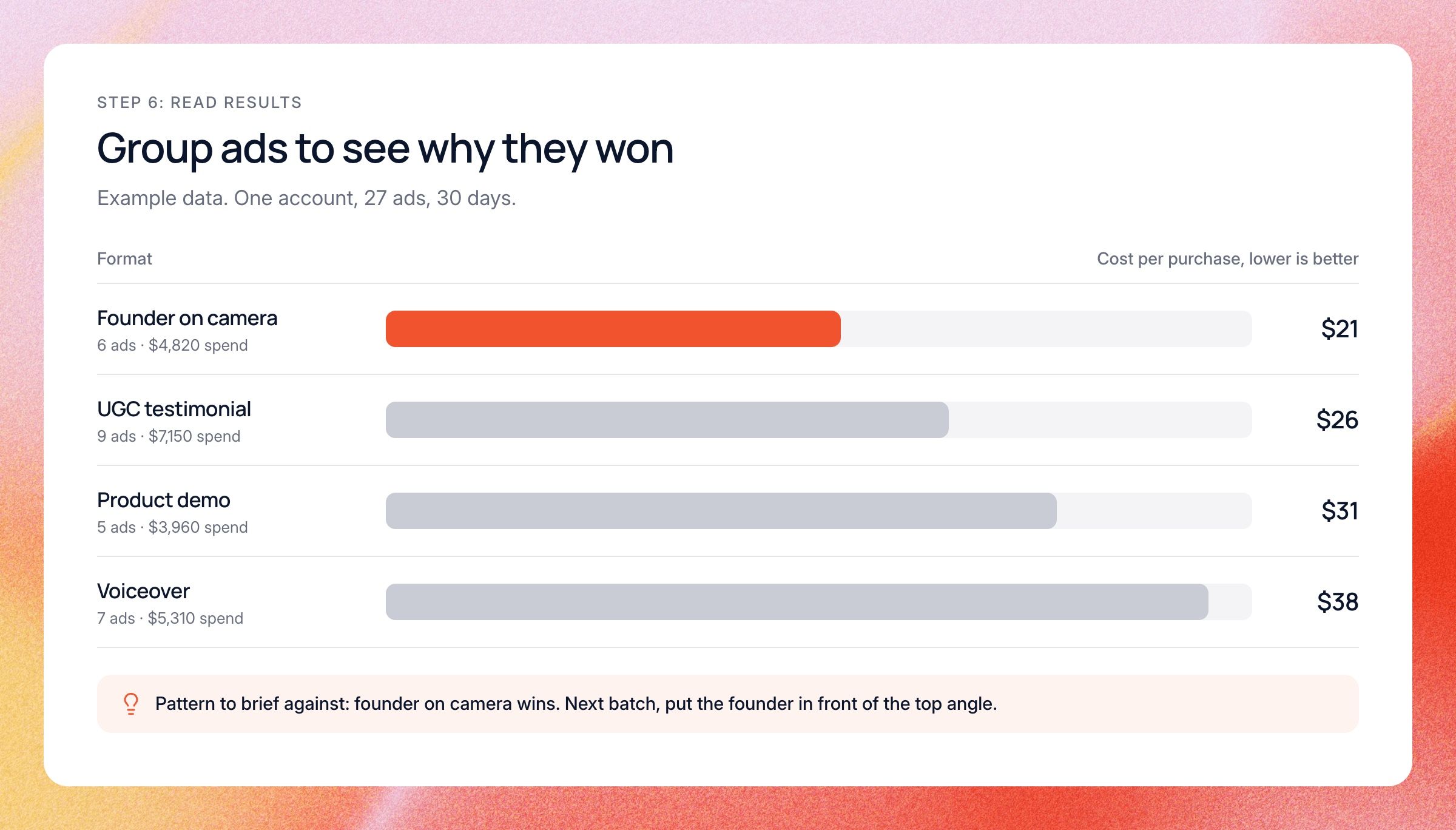
This is the step most teams rush. Sorting ads by ROAS tells you which ad won, but not why it won. The "why" is what you need for the next brief.
Group your results by angle, hook, format and who's on camera. If every ad with the founder on camera beats every voiceover ad, that's a pattern you can brief against. Also check where people drop off in the video, and whether high click rates turn into sales on the landing page.
7. Iterate
Take what you learned and go around again. Winning ads get new hooks, new formats or new creators. Losing angles get dropped or rethought, and fresh research adds new angles to the mix.
A simple rule many teams follow: spend most of each batch on versions of proven winners, and save a smaller share for brand-new concepts. The versions keep results steady. The new concepts are where your next big winner comes from.
Where to find customer insight
Your best ad ideas usually come from customers. They tell you what they care about every day, in reviews, comments and calls. These are the places worth checking first:
- Reviews: your own, plus your competitors' 3-star reviews
- Reddit and forums: how people talk when no brand is in the room
- Sales and support calls: the questions people ask right before they buy
- Comments: on your ads and your organic posts
- Competitor ads: what's already been said in your market
- Your own ad data: which angles and hooks have already worked
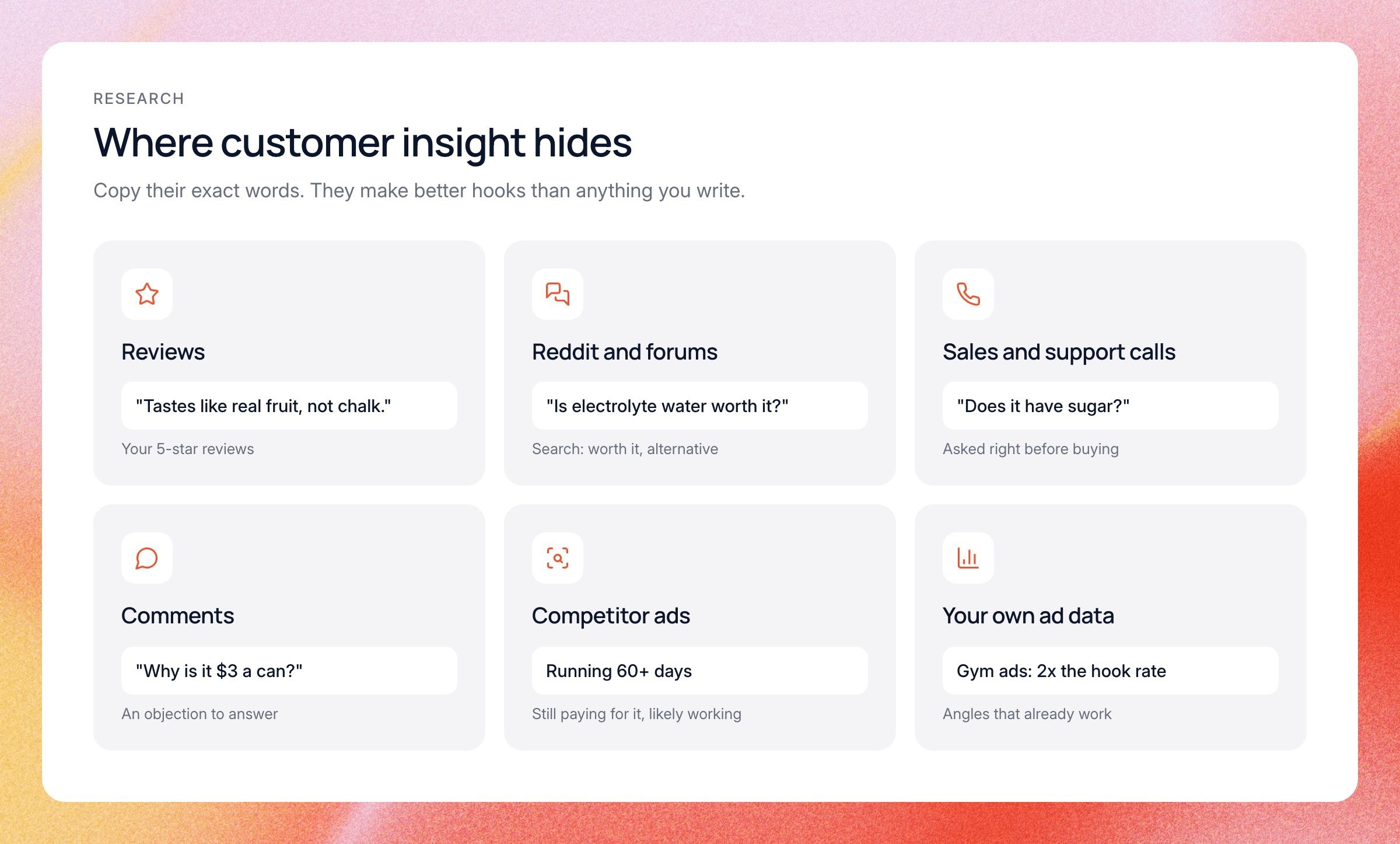
Reviews are the fastest win. Five-star reviews show what people love and the words they use to describe it. Three-star reviews of competitor products show what's missing, which is often your best angle. Copy exact phrases into a doc, because they often make better hooks than anything you'd write yourself.
Reddit shows the honest version. Search your category plus words like "worth it", "alternative" or "regret". You'll find objections you didn't know existed, and the feelings behind them.
Sales and support calls are gold if you sell something people think hard about. Listen for the moment someone decides to buy, and the questions they ask right before. If your calls are recorded, search them for words like "worried", "tried" and your competitors' names.
Comments on your ads show real reactions, including the angry ones. Repeated questions point to objections your next ad should answer. Repeated complaints can even point to a whole new angle (the Liquid Death example below shows how).
Competitor ads show what's been said and where the gaps are. The Meta Ad Library shows what's running and for how long. The harder part is working out why an ad works: the hook, the angle, the offer and the landing page behind it. Our guide on competitor ads walks through how to do that.
Angles vs hooks vs formats
These three get mixed up all the time, and mixing them up ruins tests. If you change the angle, the hook and the format at once, you can't tell which one moved the number. Keep them separate in your briefs and in your reporting.
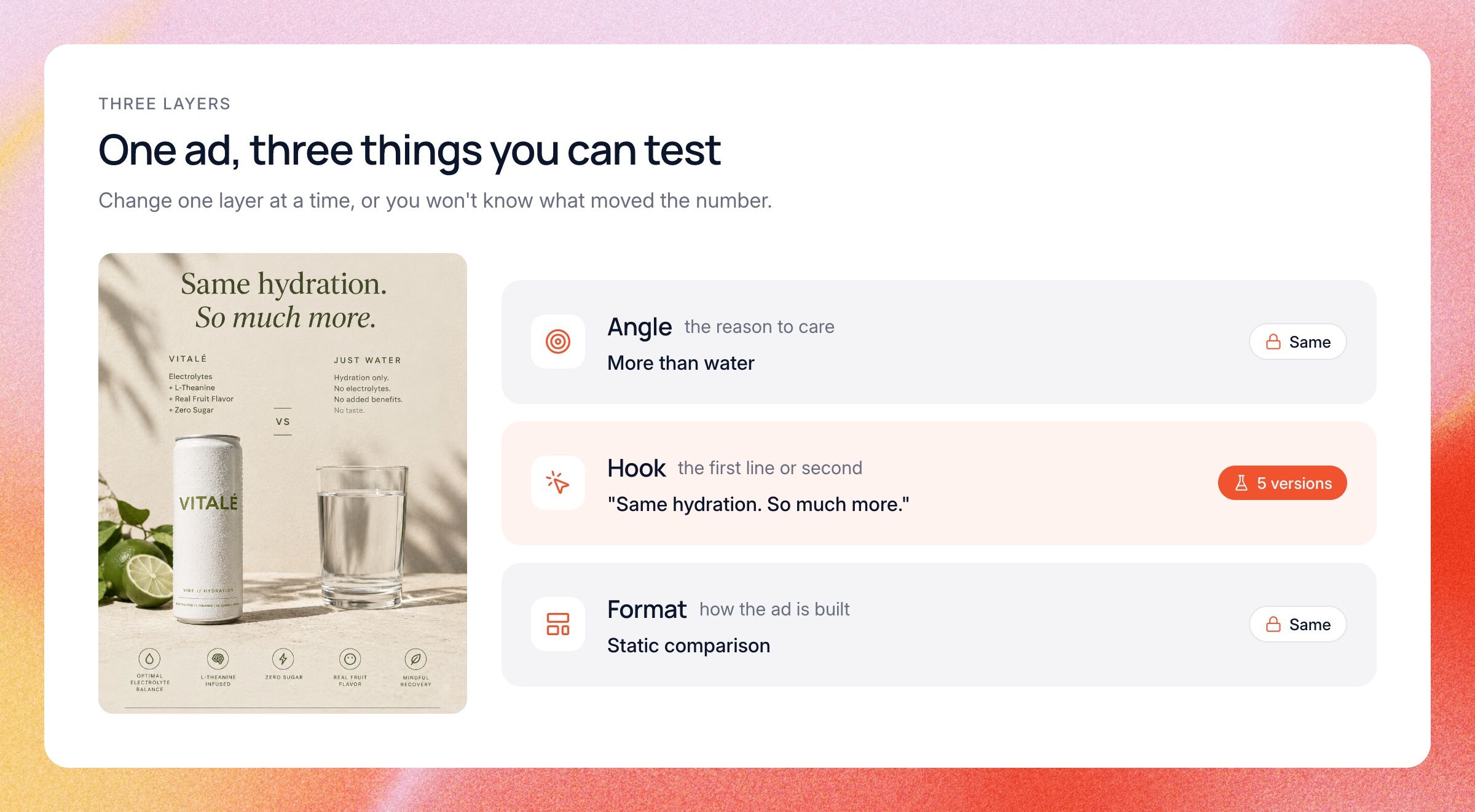
Angle is the reason to care. "Saves you an hour a week." "Made for sensitive skin." "Half the price of the big brand." One product can have dozens of angles, one for each pain, desire or type of buyer.
Hook is the first one to three seconds of a video, or the first line of copy. Its only job is to stop the scroll and make the right person keep watching. One angle can have many hooks: a bold claim, a question, a surprising visual, a customer quote. You measure it with hook rate.
Format is how the ad is built. Think UGC testimonial, founder talking to camera, product demo, static image, before-and-after, or a street interview. Some formats suit some angles better. UGC ads are great for trust and proof, while a static image can be the fastest way to test a new offer.
The habit that pays off is changing one layer at a time. Keep the angle and format the same, and test five hooks. Then keep the best hook and try the angle in a new format. That's how you build real knowledge about your account instead of a pile of random results.
Awareness stages: match the message to the buyer
Not everyone who sees your ad is in the same place. Eugene Schwartz described five stages of awareness in his 1966 book Breakthrough Advertising, and they're still the simplest way to match a message to a buyer.
- Unaware: doesn't know they have the problem yet
- Problem aware: knows the problem, but not the solutions
- Solution aware: knows solutions exist, but not yours
- Product aware: knows your product, but hasn't bought
- Most aware: ready to buy and needs a reason to act now
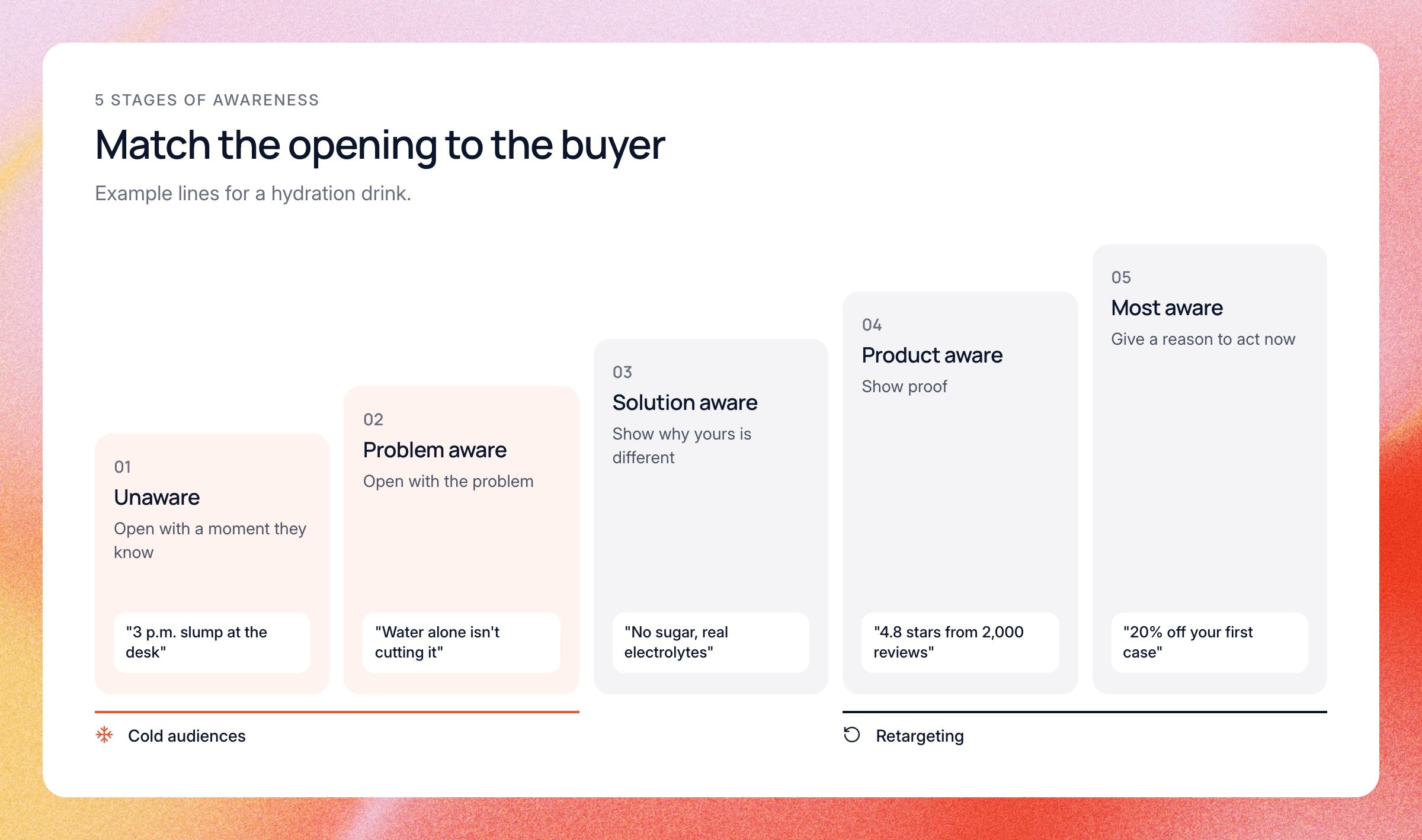
Cold audiences are mostly unaware or problem aware. Ads for them should open with the problem or a moment people recognize, not your product name. Retargeting audiences already know you, so they need proof, offers and answers to their doubts.
Many accounts lean too hard on product-aware ads, because those are the easiest to write. Adding a few problem-aware angles to each batch can find new people at a lower cost.
A creative strategy template you can copy
Here's a simple creative strategy template that works for one ad or a full batch. Copy it into a doc and fill it in for each concept. Short answers beat long ones.
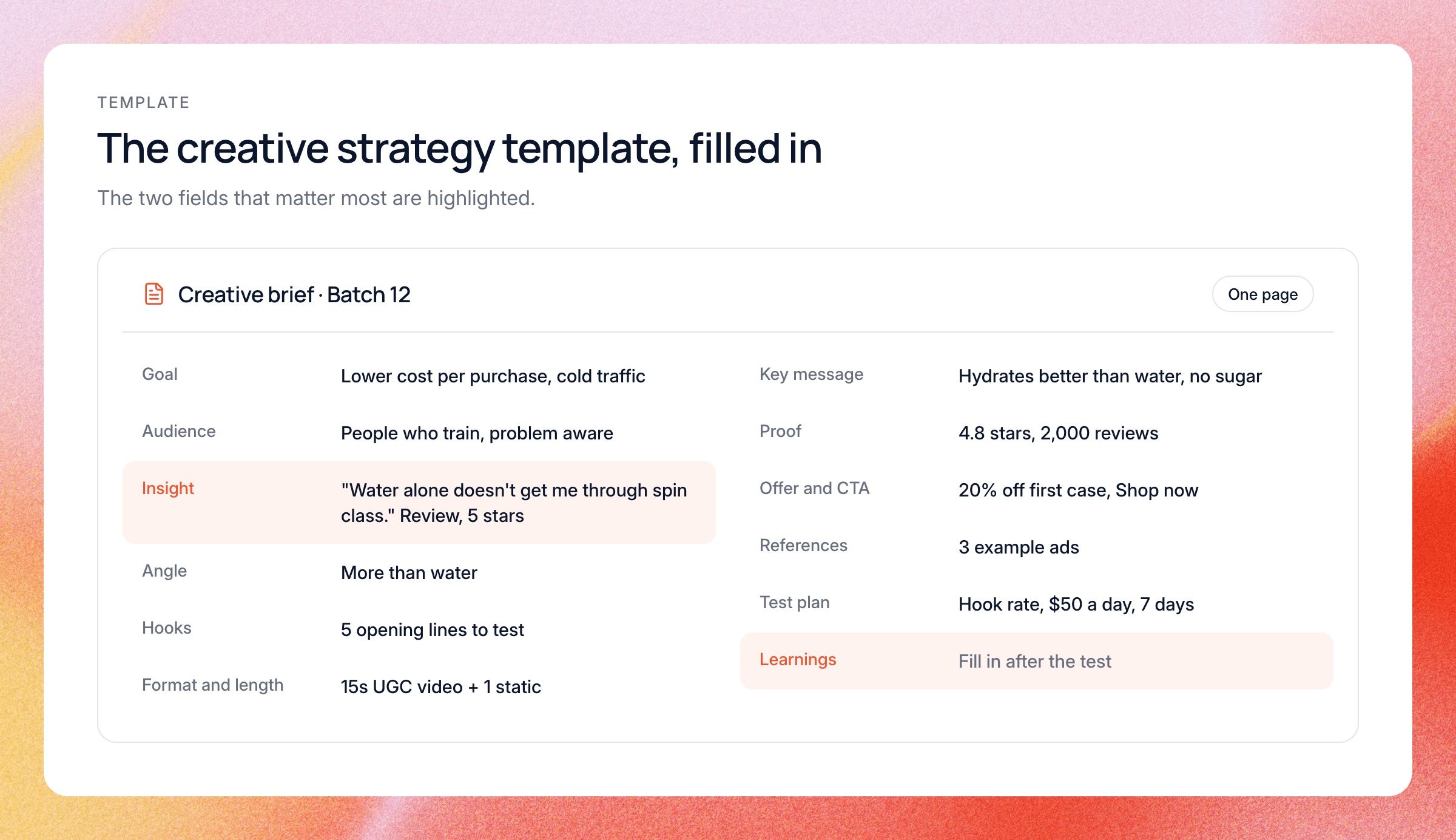
- Goal: what this batch should achieve (for example, lower cost per purchase on cold traffic)
- Audience: who it's for, and their awareness stage
- Insight: the customer truth it's built on, and where you found it
- Angle: the reason to care, in one sentence
- Hooks: three to five opening lines or visuals to test
- Format and length: UGC, founder, demo, static, and so on
- Key message: the one thing the viewer should remember
- Proof: reviews, numbers, press, before-and-after
- Offer and call to action: what you want them to do next
- References: two or three example ads that show the style
- Test plan: what you're testing, the success metric, budget and timeline
- Learnings: filled in after the test, plus what to make next
The Insight and Learnings fields matter most. Insight makes you tie every ad to something a real customer said. Learnings makes you write down what happened, so the next brief starts from evidence and not memory.
If the brief is going to a creator or designer, add a shot list and any lines they must say. Creators do their best work when they know exactly what you need and why. Keep every filled-in template in one folder, and after a few months you'll have a record of what works for your brand.
Creative strategy examples from well-known brands
These three brands show different sides of creative strategy. One is a performance launch, one is a brand that turned its comments section into content, and one is a long-running brand platform. Each started from something real about the customer.
Dollar Shave Club: one sharp angle, founder on camera
On March 6, 2012, Dollar Shave Club launched with a YouTube video starring its founder, Michael Dubin. Dubin has said it cost about $4,500 to make, and it brought in around 12,000 orders in the first 48 hours. The video is funny, but the strategy underneath is simple.
The angle was price and hassle: razors cost too much and are annoying to buy. The hook was the title line itself, "Our Blades Are F***ing Great." The format was the founder talking straight to camera while walking through his warehouse. It had one angle and one clear promise, from a person viewers could believe. Founder-to-camera ads are now a common format in paid social.
Liquid Death: turning hate comments into creative
Liquid Death sells canned water with a heavy metal look, and that draws a lot of hate online. In 2020, the brand released Greatest Hates, a metal album where every lyric was a real hate comment about the brand. It has released more volumes since.
This is customer research turned straight into creative. The team read the comments, spotted a pattern, and made the objection itself the joke. It also shows brand-level creative strategy at work, with a clear personality that every ad, post and product drop follows. If the same complaint keeps showing up in your comments, it might be the start of your next ad.
Dove: one insight, years of campaigns
Dove's Campaign for Real Beauty started in 2004. It grew out of a global study Dove commissioned, which found that only 2% of women described themselves as beautiful. That insight shaped years of ads, including the widely shared Real Beauty Sketches film in 2013.
This is creative strategy in the classic brand sense. Dove kept one customer truth and one point of view, and found many ways to express them. Performance teams can learn from it too: when an angle comes from a real insight, you can keep making new ads from it for a long time.
What does a creative strategist do?
A creative strategist owns the loop. They decide what gets made next and why, then check whether it worked. The role sits between the media buyers, who watch the numbers, and the creative team, who make the ads.
A typical week includes reading last week's results, digging through reviews and comments, scanning competitor ads, writing briefs for creators and designers, and reviewing edits before launch. Good strategists are curious about customers, comfortable with data, and able to explain an idea clearly enough that someone else can make it.
You'll find creative strategists at DTC and app brands, and at performance and creative agencies. Many come from media buying, UGC creation, copywriting or social media. The title is fairly new, but the skills behind it are old: know the customer, make a guess, test it, and learn.
How this works in Lemonado
The two slowest steps in the loop are research and reading results. Lemonado's Creatives workspace helps with both. It pulls in your ads from Meta, Google (including YouTube), TikTok, LinkedIn, Pinterest and Snapchat, and shows hook score, hook rate, hold rate, where viewers drop off and a fatigue score for each creative.
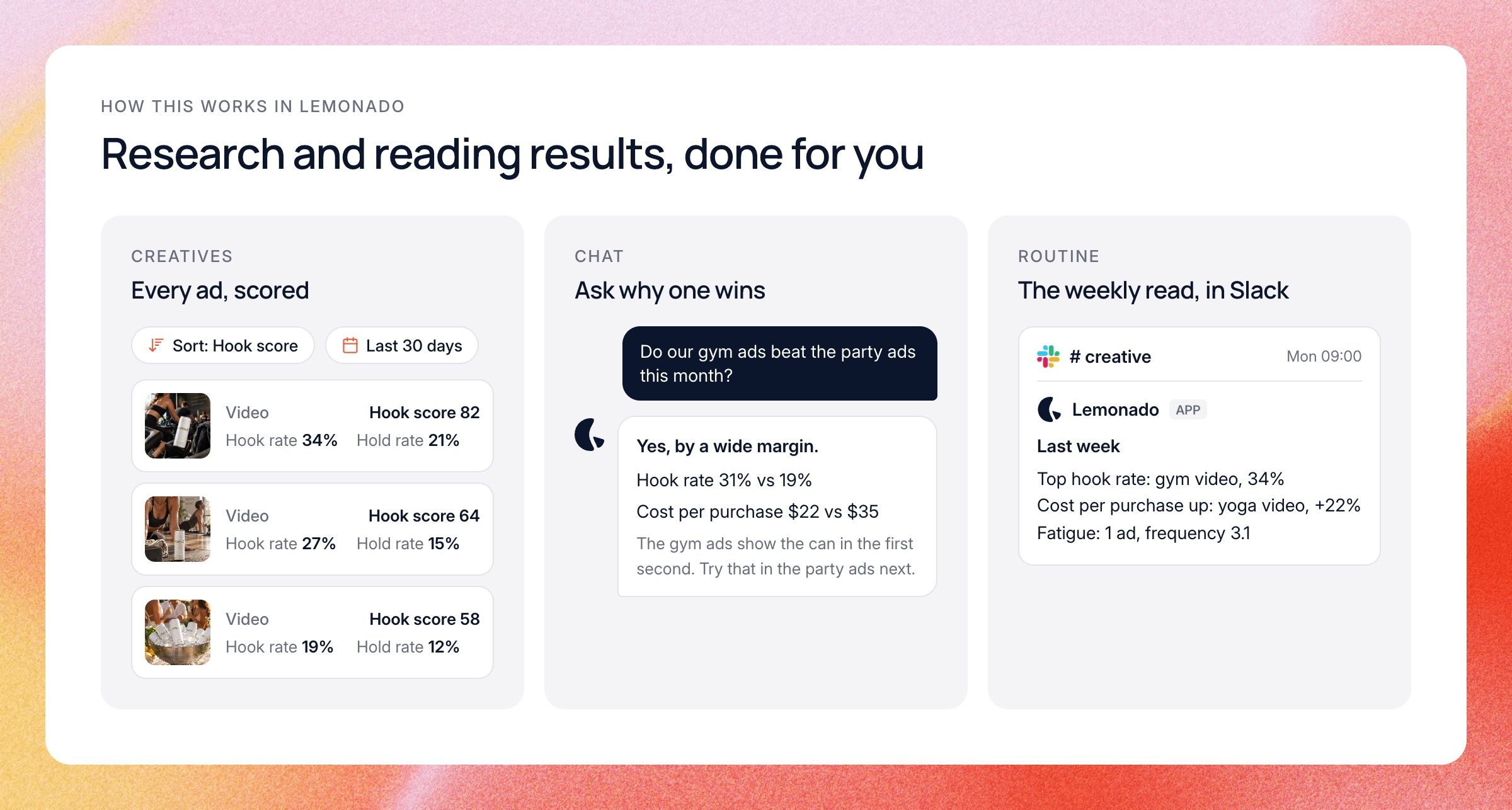
You can pull up creatives in Chat or straight from Slack and ask why one wins. You can also ask Lemonado to compare your ads by hook or angle, for example "do founder-on-camera ads beat voiceover ads this month?" Share links and per-ad comments make creative reviews with your team or client easier.
For research, Discover lets you browse competitor ads and save what you find to your team as reports. Lemonado reads the why behind each ad: the hook, the angle, the offer, who's on camera and the landing page. Discover works in the free trial, even before you connect an ad account.
You can also hand off the weekly read as a Routine. For example, every Monday Lemonado can post last week's top ads by hook rate, the ads whose cost per purchase went up, and any ads showing creative fatigue to Slack. Lemonado doesn't make your ads, but it gives your strategists and creators the evidence to brief the next ones.
Do this with AI
You can try the "read results" step today with ChatGPT or Claude and an export. Pull an ad-level export from Ads Manager with spend, impressions, 3-second video views, link clicks, purchases and revenue. Then add columns that tag each ad by angle, hook type, format and creator before you paste it in.
You are a senior creative strategist for paid social. Below is an ad-level export from the last 30 days. Each row is one ad, with columns for angle, hook type, format, creator, spend, impressions, 3-second video views, link clicks, purchases and revenue. 1. Calculate hook rate (3-second views divided by impressions), CTR, cost per purchase and ROAS for each ad. Only include ads with at least [X] in spend. 2. Group the results by angle, then by hook type, then by format. For each group, show total spend, average hook rate, CTR and cost per purchase. 3. Name the top 3 patterns that explain why the winning ads won. Use the numbers. 4. Flag ads where hook rate is high but CTR is low (the body or offer is losing people), and ads where CTR is high but purchases are low (check the landing page). 5. Suggest 5 new ad concepts for next week. For each one, give the angle, three hook ideas, the format, and which result it builds on. Return a short table for each grouping, then the 5 concepts as a list I can paste into a brief. Data: [paste your export here]
Tagging is the slow part. Once your ads are tagged, the AI can spot patterns fast. Run it every week and save each answer in one doc, so your learnings stack up over time.
FAQs
These are the questions we hear most about creative strategy. Some are about the basics, and some are about running it day to day. Short answers below.
What is creative strategy in simple terms?
Creative strategy is deciding what your ads should say and show, and to whom, based on what you know about your customers. In paid social, it's also the weekly habit of testing ads and using the results to plan the next ones. Think of it as the bridge between your marketing goal and the ad someone sees in their feed.
What is an example of a creative strategy?
A simple example: a skincare brand reads its reviews and finds many buyers mention sensitive skin. It makes "finally, a cleanser that doesn't sting" its main angle, tests five hooks in UGC videos, and finds that hooks showing a red, irritated face before use win. The next batch keeps that hook style and tries it in a before-and-after static. The Dollar Shave Club, Liquid Death and Dove examples above show the same idea at a bigger scale.
What are the seven creative strategies?
This list comes from Charles F. Frazer's 1983 Journal of Advertising paper, "Creative Strategy: A Management Perspective." The seven types are generic, preemptive, unique selling proposition, brand image, positioning, resonance and affective (sometimes called anomalous). They describe the main ways a brand can frame its message and still help with brand campaigns, while paid social teams tend to think in angles, hooks and formats.
What's the difference between a creative strategy and a creative brief?
The creative strategy is the overall plan: who you're talking to, the insights, the angles and how you test. A creative brief is the instruction sheet for one ad or one batch. The strategy decides what's worth making, and the brief tells someone exactly how to make it.
How often should you update your creative strategy?
The loop itself should run every week or two for most paid social accounts, depending on your spend and how fast you can produce ads. The bigger picture (your core angles and audience) changes less often, usually every quarter or when you launch something new. If your best ads are wearing out faster than you can replace them, speed up the loop.
Do you need a creative strategist?
Not as a separate hire at first. In small teams, the founder, the media buyer or a marketer often owns the loop. Once you're spending enough that you need new ads every week, someone should own research, briefs and results full time, because that work gets skipped when nobody owns it.
Get started
Creative strategy comes down to knowing your customer, testing on purpose, and reading results well enough to know why something worked. The research and the reading are where most teams lose time. Speed those up and the rest of the loop gets easier.
Try Lemonado free. Get $150 in credits, no card needed. Connect your ad accounts, see which ads and hooks are winning right now, and ask Lemonado why.