

Most ad accounts run out of winning ads long before they run out of budget. Making more ads won't fix that on its own. What fixes it is a steady way to find out which ads work, and why, before real money goes behind them. That's what creative testing gives you.
This guide gives you a simple creative testing framework you can run every week. It covers how to set up tests on Meta now that Andromeda decides who sees what, which numbers pick a winner, how to read results, the mistakes that waste budget, and the ad creative testing platforms worth knowing.
What creative testing is
Creative testing is how you compare ads against each other to learn which ones bring results at a cost you can live with. You change the creative, keep everything else as steady as you can, and let real spend show you the answer. Finding a winner is half of it. The other half is learning what your buyers respond to, so every next ad starts from a better guess.
On Meta, TikTok and YouTube, the creative now does most of the targeting. Broad audiences are the default, and the platform reads your ad to decide who should see it. So when you test an ad, you're also testing who it reaches. For the short version, see our creative testing glossary entry.
Creative testing vs creative pre-testing
Creative pre-testing happens before an ad goes live. A research panel watches the ad and scores it on things like attention, emotion and how well people remember the brand. Big brand teams use it for TV and expensive video, where a bad launch costs a lot. Live creative testing happens inside the ad platform with real spend and real buyers. For most performance teams, live testing is faster and cheaper, and it measures the thing you care about: sales and leads.
Concept tests vs iteration tests
There are two kinds of creative tests. Mixing them up is one of the easiest ways to run a test that teaches you nothing.
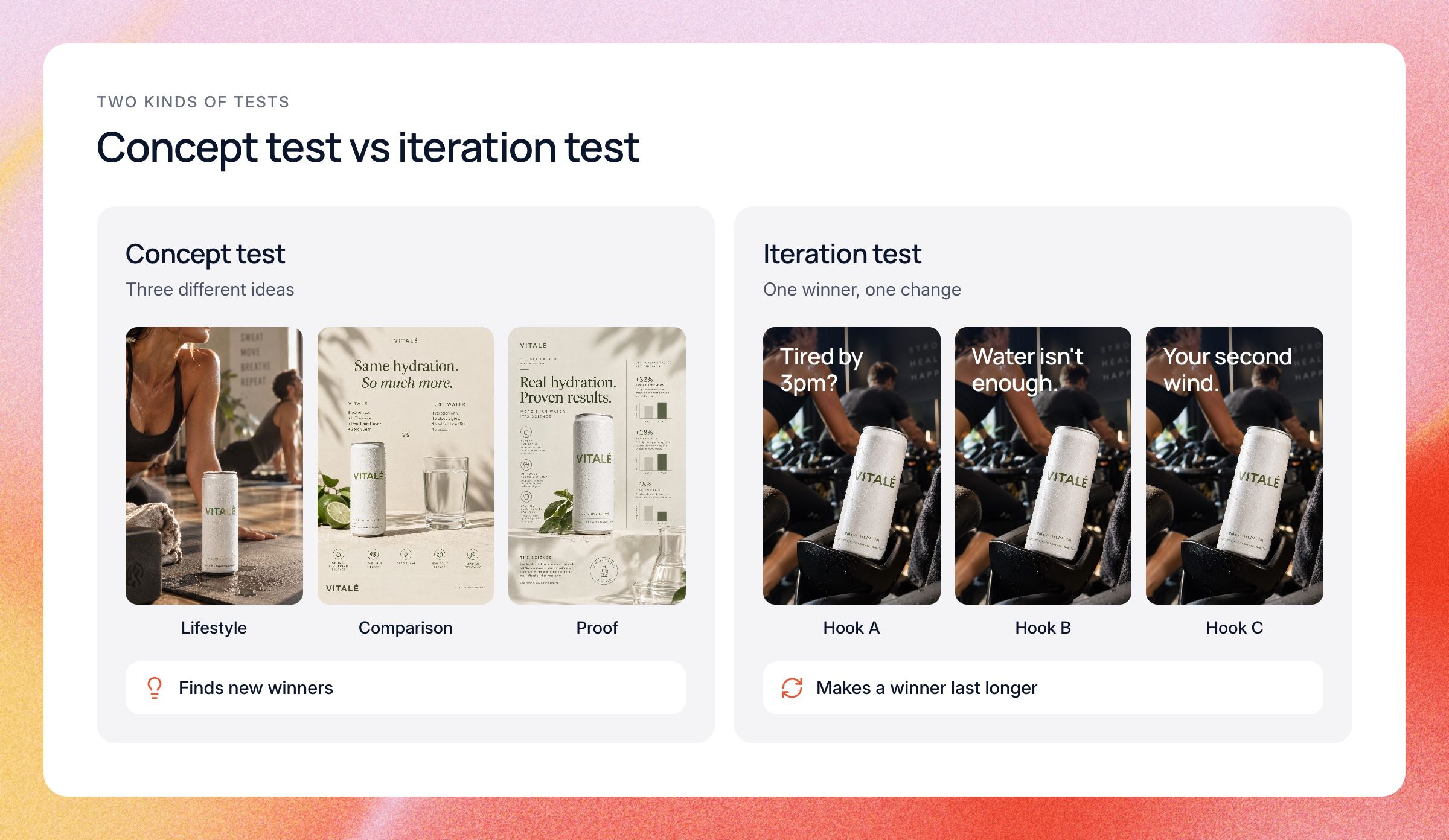
- Concept test: compares big ideas. A different angle, a different promise, a different person on camera, or a different format.
- Iteration test: takes a winning concept and changes one part. A new hook, a new first frame, a shorter cut, or a new headline.
Concept tests find new winners. Iteration tests make a winner last longer and cost less. A healthy account runs both, but most teams put the bigger share of their testing budget into concepts, because one new winning idea usually moves results more than a string of small tweaks.
Why creative testing matters more now
Meta's Andromeda update changed how ads get picked. Andromeda is the first step in how Meta chooses which ads to show to which person, and it pays close attention to the creative itself. Meta's advice since then has been to run more varied creative. In practice, ads that look and sound too alike tend to compete for the same people instead of reaching new ones.
That changes testing in two ways. First, the number of clearly different ideas you put live matters more than the number of ads. Ten versions of one video with different text on top behave a lot like one idea. Second, targeting tricks matter less than they used to, so the creative is the biggest lever you control.
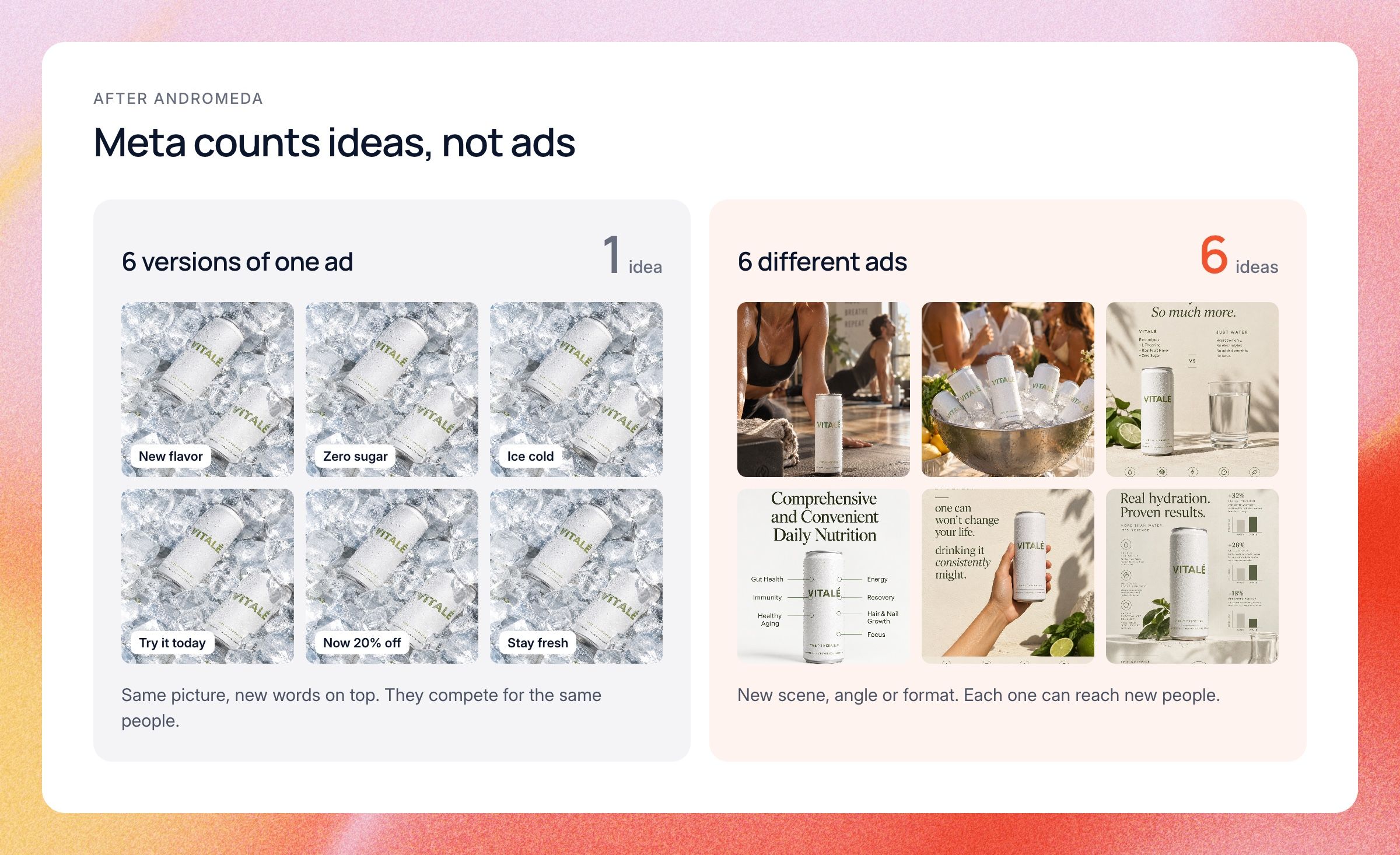
It also means ads wear out faster when you only feed the system small tweaks. If your best ad is slipping and you're not sure why, our guide to ad fatigue shows how to check.
A simple creative testing framework
Here is the framework we use. It fits on one page, and the steps stay the same whether you spend a few thousand a month or a few hundred thousand, with only the budget changing.
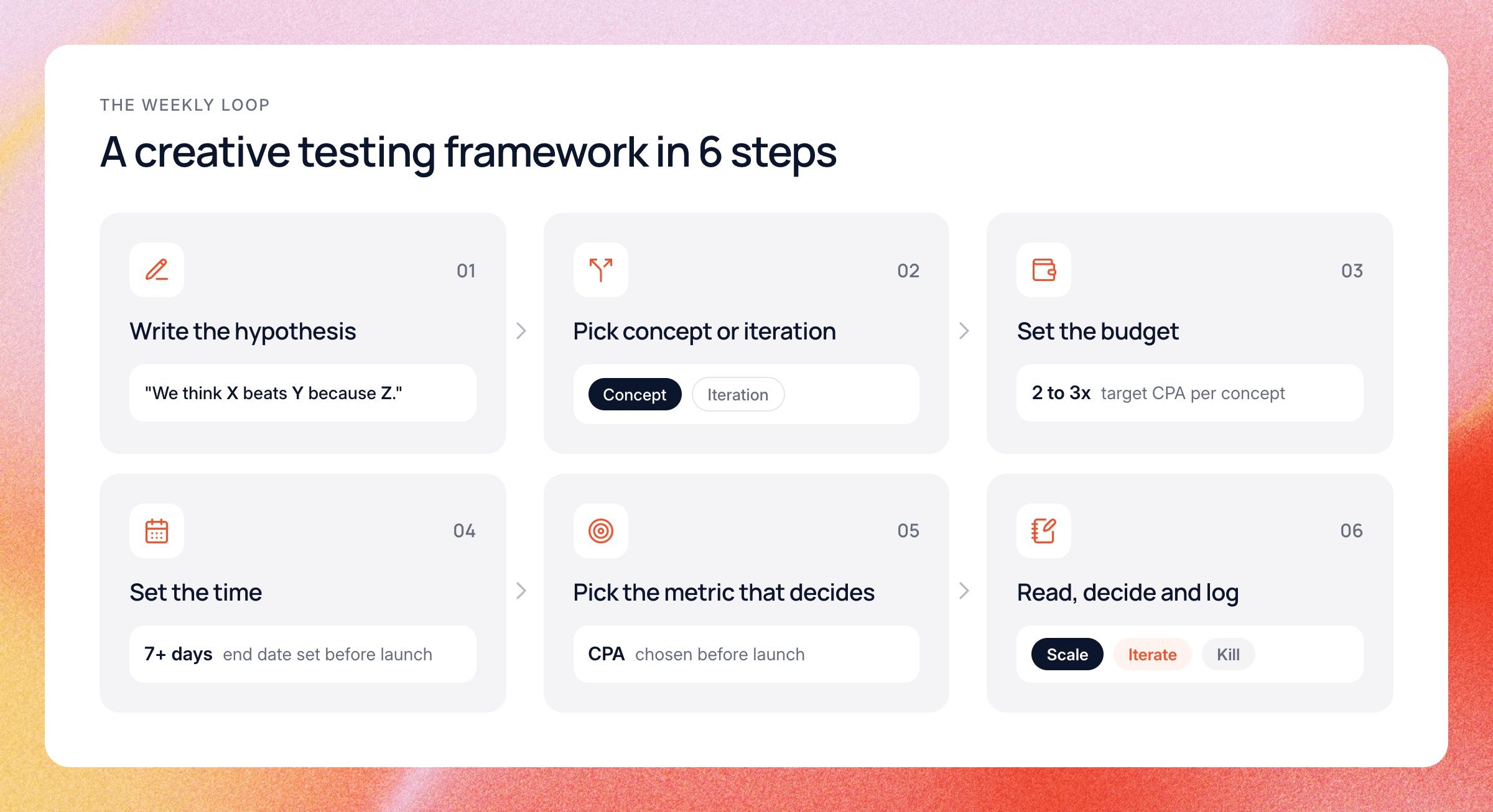
- Write the hypothesis.
- Pick concept or iteration.
- Set the budget.
- Set the time.
- Pick the metric that decides.
- Read, decide and log.
1. Write the hypothesis
Every test starts with one sentence: "We think X will beat Y because Z." For example, "We think a founder talking to camera will beat a product demo, because buyers trust a real person more." This keeps the test honest. If you can't write the sentence, you're launching ads and hoping, not testing.
2. Pick concept or iteration
Decide if this is a concept test or an iteration test before you build anything. For a concept test, make each ad clearly different in angle, format or messenger. For an iteration test, keep the body of the ad the same and change one part, most often the first three seconds. If you change five things at once, you'll find a winner but you won't know why it won.
3. Set the budget
The budget has to be big enough to give you a real answer. A good starting point is to let each concept spend two to three times your target cost per acquisition (CPA) before you judge it on cost. If your target CPA is $40, that means $80 to $120 per concept. Adjust it once you see how fast your account gathers results.
If that's more than you can spend, judge in two rounds. Cut clear losers early on hook rate and click-through rate, which show up with less spend. Then give the survivors enough money to prove themselves on CPA. A common habit is to keep around 10 to 20 percent of the total ad budget for testing so new ideas never starve. Treat that as a place to start, not a fixed number.
4. Set the time
A sensible default is to run each test for at least seven days. People buy differently on a Monday than on a Saturday, and the first day or two is noisy while the platform learns who to show the ad to. Set the end date before you launch and stick to it. Stopping when you happen to like the numbers is how teams fool themselves.
5. Pick the metric that decides
Choose the deciding metric before the test starts. Different metrics answer different questions, so read them in order, from the top of the funnel down.
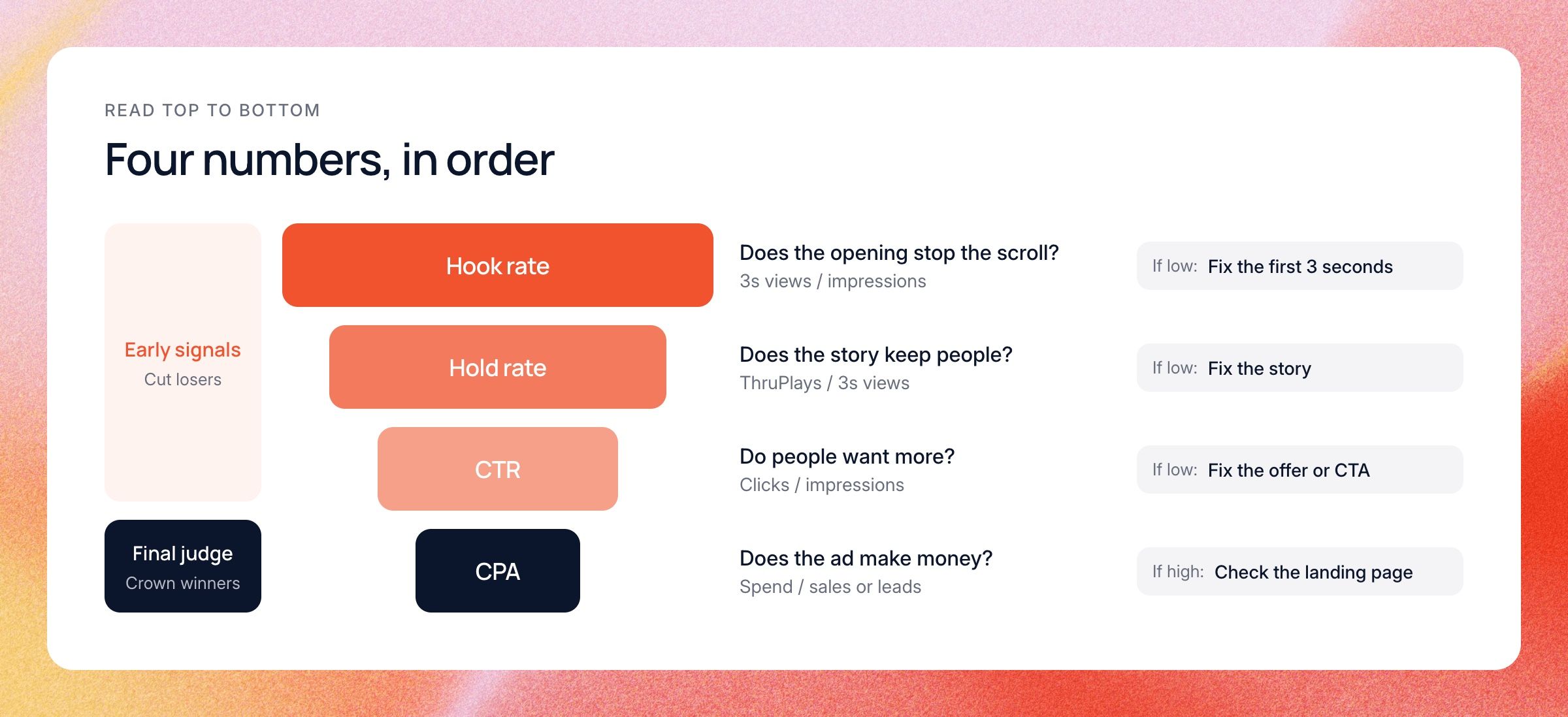
- Hook rate: the share of impressions that watched at least three seconds. It tells you if the opening stops the scroll.
- Hold rate: the share of those viewers who keep watching. A common version is ThruPlays (views of 15 seconds, or the whole video if it's shorter) divided by three-second views. It tells you if the story keeps people.
- CTR (click-through rate): the share of impressions that clicked. It tells you if the ad makes people want more.
- CPA (cost per acquisition): what you paid per sale or lead. It tells you if the ad makes money.
Hook rate, hold rate and CTR are early signals. They show up fast and need less spend. CPA (or ROAS for ecommerce) is the final judge, because a hook that grabs the wrong people will look great and sell nothing. Use the early signals to cut losers and the money metric to crown winners. Our hook rate page goes deeper on the first one.
6. Read, decide and log
When the test ends, make one of three calls: scale it, iterate on it, or kill it. Then write down what you learned in one line, like "Problem-first hooks beat product-first hooks for cold audiences." This log is the real output of creative testing. After a few months, it tells your team what to make next without guessing.
How to run creative testing on Meta after Andromeda
There are three common ways to set up Facebook creative testing today. None of them is perfect. Pick based on how much you spend and how clean you need the answer to be.
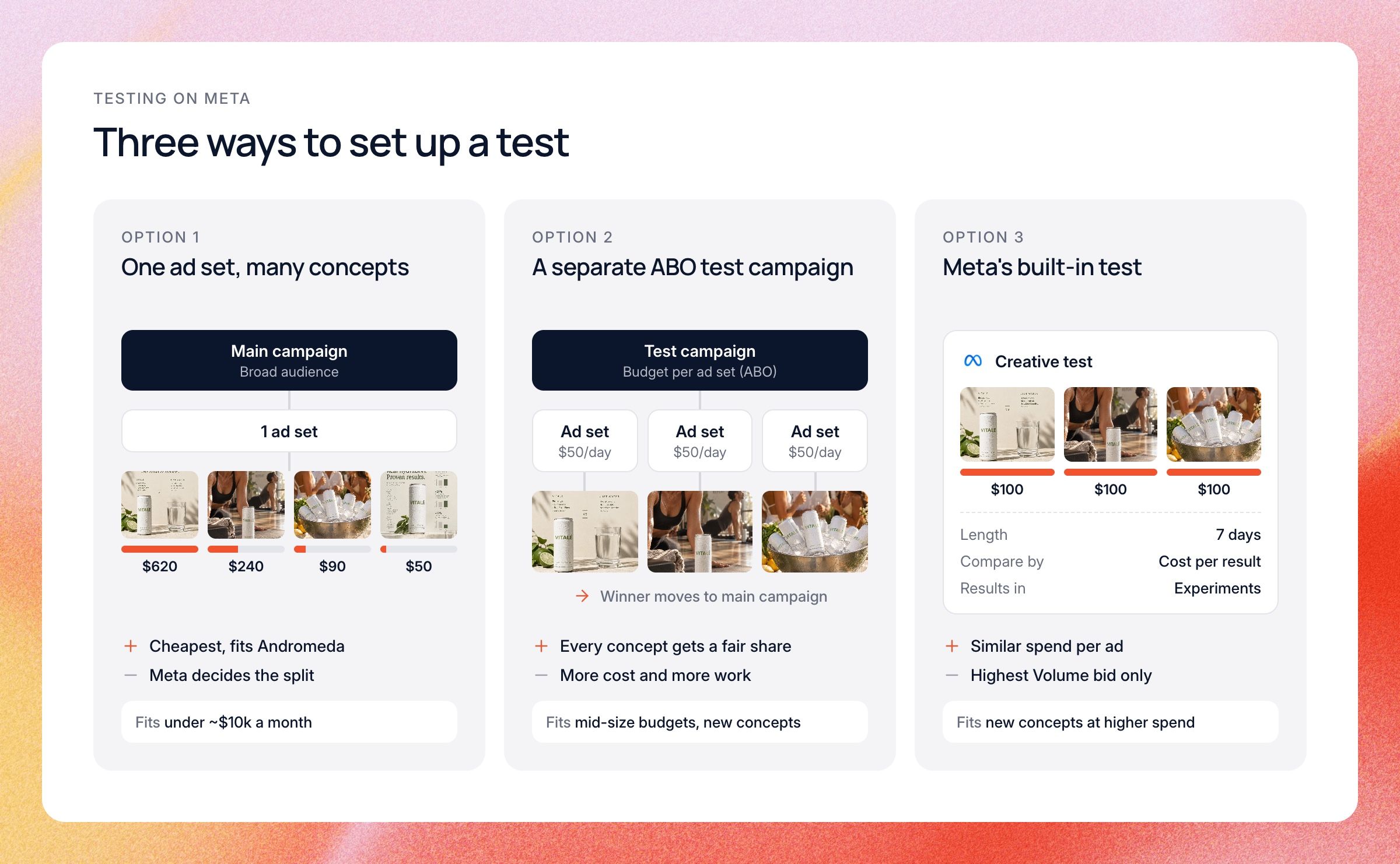
Option 1: One ad set, many concepts
Put several different concepts into one ad set inside your main campaign, with a broad audience. Meta spends more on the ads it expects to work, and you watch which ones it picks and how they perform. This setup fits best with how Andromeda works, and it's cheap because you're not splitting your budget across lots of ad sets.
The downside is that Meta decides how the money gets split. Some ads get almost nothing and never get a fair shot. If a new concept gets very little spend after three or four days, don't count that as a loss. Give it its own ad set, or try it again with a stronger hook.
Option 2: A separate ABO test campaign
Create a testing campaign with budgets set at the ad set level (often called ABO). Give each concept its own ad set with the same budget and the same broad audience. Every concept gets a fair share of spend, so the comparison is much cleaner.
When a concept wins, move it into your main campaign. Use the same post ID so it keeps its likes and comments. This setup costs more and takes more work to manage, and the winner has to prove itself twice. Many teams with mid-size budgets still use it, because they trust the answer more.
Option 3: Meta's built-in tests
Ads Manager has a creative testing option at the ad level. You start from an existing or draft ad, Meta makes a small set of copies that you edit into the versions you want to compare, and you set a test budget, a length (seven days by default) and the metric to compare, such as cost per result. During the test, Meta aims to give each ad a similar share of spend, and the full results show up in the Experiments section. It only works with the Highest Volume bid strategy, and it tests the new copies, not ads that are already running.
For the strictest head-to-head, Meta's A/B test splits the audience so nobody sees both versions. It's the cleanest answer Meta offers. It's also the slowest and priciest, so save it for big bets like a new offer or a new format.
Which setup should you use?
As a rough starting point, if you spend under about $10,000 a month on Meta, start with one ad set and many concepts. At that level it's hard to split budget cleanly, so let the system work and judge on early signals. If you spend more, use an ABO test campaign or the built-in test for new concepts, and test iterations of proven winners inside your main ad set. Whatever you pick, keep the setup the same every week so this week's results compare to last week's.
How to read creative test results
Reading results is where most teams lose the lesson. A test tells you which ad won. The real work is figuring out why, so the next brief is better.
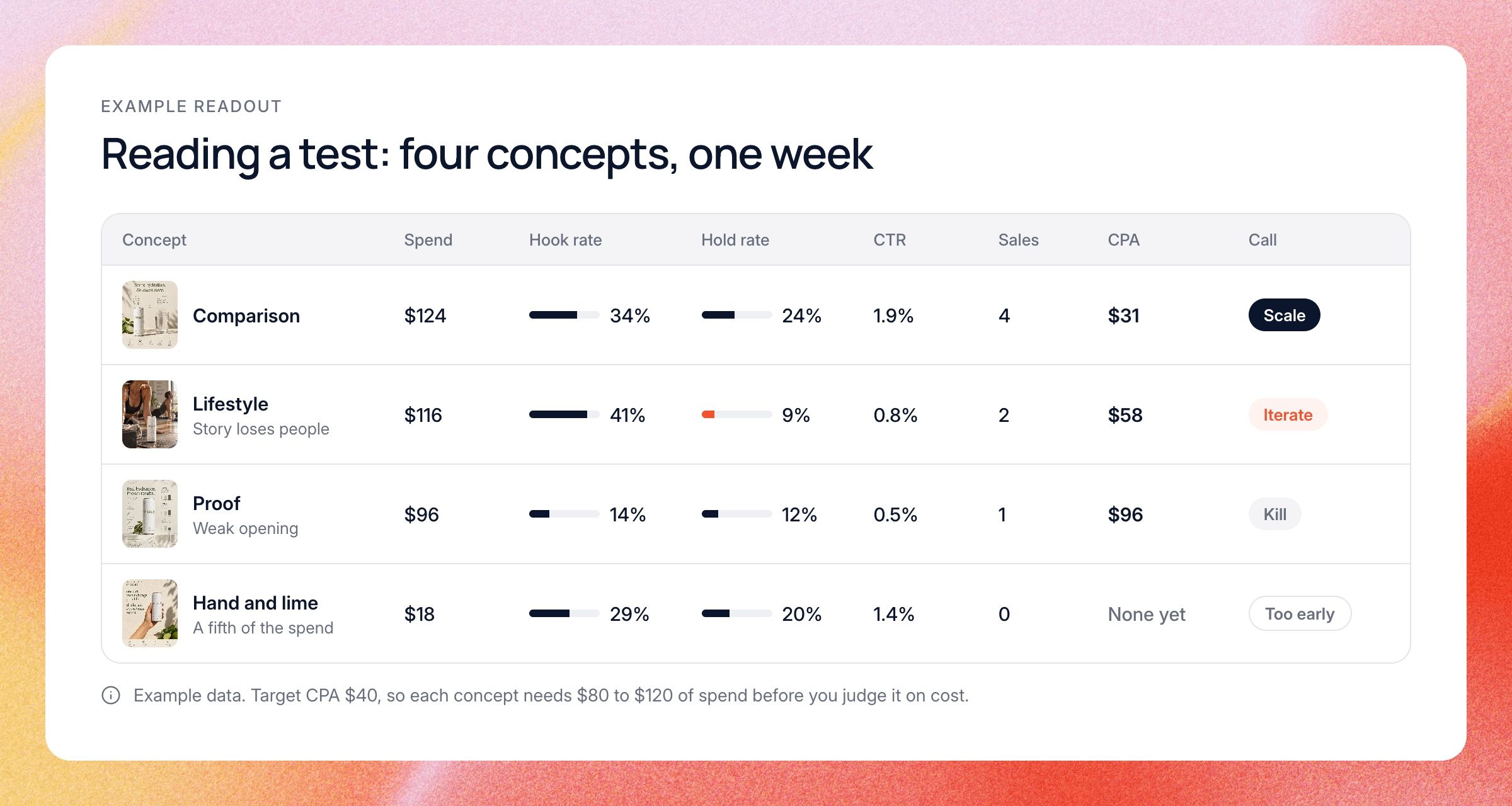
Start by checking the test was fair. Did each ad get enough spend and impressions? Did one ad start a day late because it was stuck in review? If a concept got a fifth of the spend, you don't have a result for it yet.
Then read the funnel from top to bottom. If hook rate is low, the opening is the problem. If hook rate is high but hold rate falls off, the story loses people after the hook. If people watch but don't click, the offer or call to action isn't landing. If they click but don't buy, check the landing page before you blame the ad.
Finally, compare concepts, not single ads. Group your ads by angle, format and who's on camera, then compare the groups. One winning ad might be luck. Five ads with the same angle all beating your average is a pattern you can build on.
Common creative testing mistakes
Most failed tests fail for the same handful of reasons. Here are the ones we see most.
- Testing small tweaks as if they were new concepts
- Calling a winner after two days
- Changing the budget or audience in the middle of a test
- Judging only on CTR or only on hook rate
- Putting brand-new ads up against old winners with months of data
- Not writing down what you learned
Testing new ads straight against your best old ad is unfair, because the old ad has history and social proof the new one doesn't. Test new against new first, then let the winner take on the champion. Changing budgets mid-test resets learning and muddies the numbers, so set it and leave it. Judging on a single top-of-funnel metric is how teams end up scaling ads that get attention but don't sell.
The last mistake is the easiest to miss. If nobody writes down the lesson, the team runs the same test again six months later. A one-line log after every test is the cheapest fix in this whole guide.
Ad creative testing platforms
Ad creative testing platforms fall into four groups. Some read your results and tell you why ads won. Some run the split inside the ad platform. Some act on the result with rules, and some score ads with research panels before they go live. Most teams need one tool to run tests and one to read them.
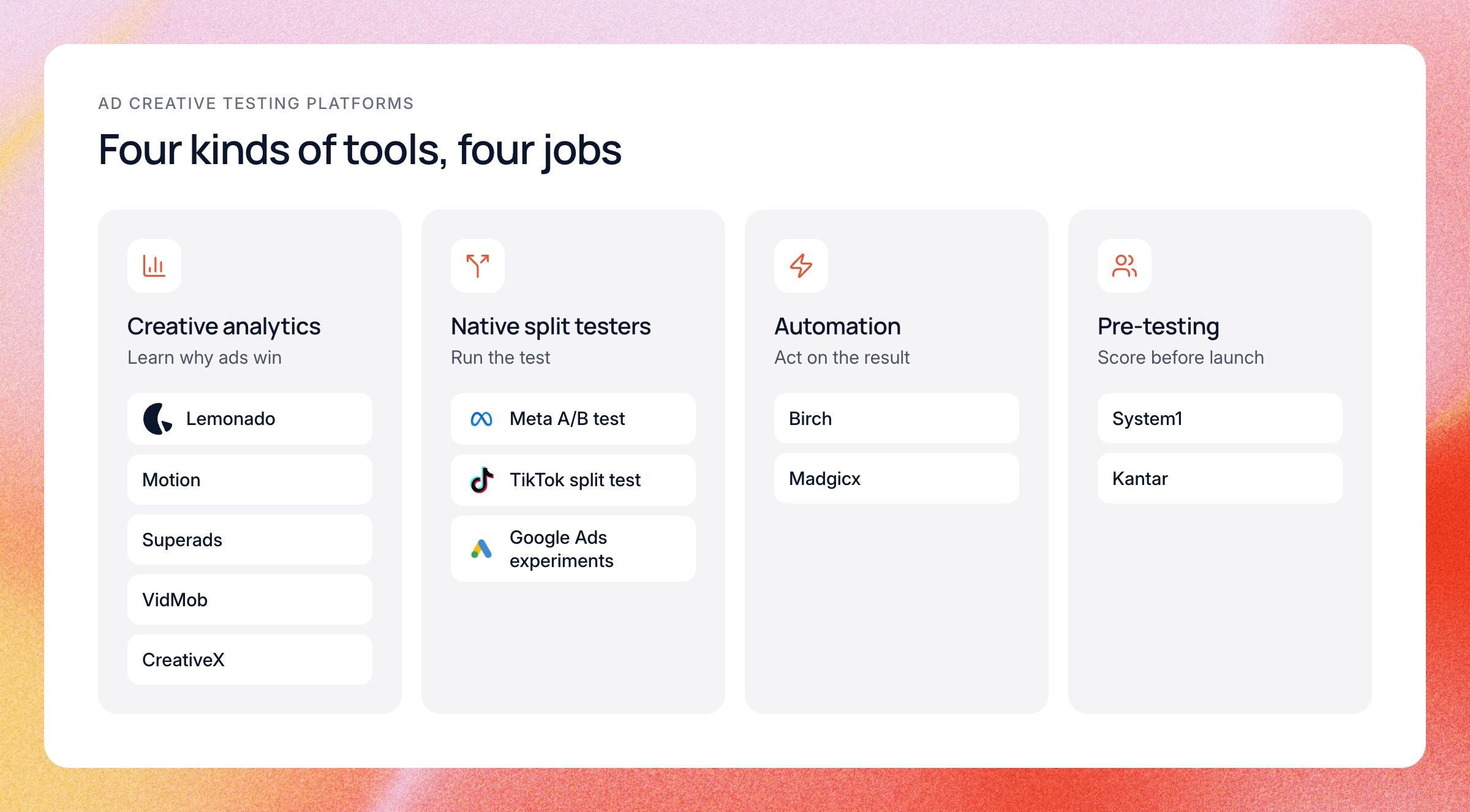
Creative analytics: learn why ads win
- Lemonado. The AI co-worker for marketing. Its Creatives workspace gives every ad a hook score, tracks hold rate, completion and fatigue, and lets you compare ads side by side across Meta, Google (including YouTube), TikTok, LinkedIn, Pinterest and Snapchat.
- Motion. A creative analytics tool for paid social, with visual reports and tagging that help you spot patterns across ads.
- Superads. Creative analytics with reports on how each ad and creative element performs.
- VidMob. Creative data and scoring for large brands with many markets and agencies.
- CreativeX. Creative quality scoring for big brand teams, checked against brand and platform guidelines.
These tools don't split traffic. They read the tests you run in the ad platforms and help you work out why a winner won. If you test on more than one platform, pick one that pulls them all into one view, so a concept that wins on Meta and flops on TikTok shows up side by side.
Native split testers: run the test
- Meta A/B test and creative testing in Ads Manager. Clean splits for Facebook and Instagram, with results in the Experiments section.
- TikTok split test. Splits your audience into equal groups so each group sees one version.
- Google Ads experiments. Test changes against a control inside Google campaigns, including video on YouTube.
These are free beyond your ad spend, and they should be your first choice for running tests. They give you a fair split, but each one only sees its own platform. They also tell you which ad won, not which part of it did, so pair them with an analytics tool to get the lesson.
Automation: act on the result
- Birch (formerly Revealbot). Rules that pause losers and scale winners once the limits you set are hit.
- Madgicx. An AI ad manager for Meta that shifts budget toward winners and tracks which creatives are working.
Automation tools carry out decisions you've already made. They're useful when you run many tests and don't want someone watching ad sets at midnight. They won't tell you which idea to test next, so they sit next to an analytics tool, not in place of one.
Pre-testing: score before launch
- System1 Test Your Ad. Panel-based testing that predicts how well an ad will work from how people feel when they watch it.
- Kantar. Creative pre-testing and ad effectiveness research for big brand campaigns.
Pre-testing suits TV spots, brand films and big-budget video, where you want a read before you spend media money. It's slower and costs more per ad than a live test. For weekly performance creative on Meta or TikTok, a live test with real spend is usually the better answer.
How to choose
Start with the native testers, because they cost nothing extra. Add an analytics tool when you have more tests than time to read them, or when you test on more than one platform. Add automation once your rules are clear and your volume is high. Only add pre-testing if you run expensive brand work that can't afford a miss.
Do this with AI
You can run a solid creative test readout with any AI assistant and an export from Ads Manager. Export one row per ad for the test period with spend, impressions, three-second video plays, ThruPlays, link clicks and results. Then paste it under this prompt.
You are a senior performance marketer. Below is an export from Meta Ads Manager for a creative test. Each row is one ad, with ad name, ad set, spend, impressions, 3-second video plays, ThruPlays, link clicks and results (purchases or leads). The concept name is the first part of each ad name, before the first underscore. 1. Group the ads by concept. 2. For each concept, calculate spend, hook rate (3-second plays / impressions), hold rate (ThruPlays / 3-second plays), CTR (link clicks / impressions) and cost per result. 3. Flag any concept that spent less than 2x our target cost per result of [$X]. Mark it "too early to call". 4. For the rest, label each concept Scale, Iterate or Kill, and explain why in one sentence using the numbers. 5. For each Iterate, say which part to change (hook, story, offer or landing page) based on where the funnel drops. 6. Write one line on what this test taught us that we should use in the next brief. Return a table sorted by spend, then a 5-line summary I can paste into Slack. Data: [paste your export here]
This works well for one test on one platform. It gets harder when you test on Meta, TikTok and YouTube at once, or when you have to rebuild the export every Monday, and that repeat work is the part worth handing off.
How this works in Lemonado
Lemonado connects to your ad accounts and keeps your creative data in one place, so you don't export anything. In Creatives, every ad gets a hook score along with hook rate, hold rate, completion and where viewers drop off. You can compare ads side by side across Meta, Google (including YouTube), TikTok, LinkedIn, Pinterest and Snapchat, and ask Lemonado to compare them by hook or angle. It also gives each ad a fatigue score, so you know when a winner needs a refresh.
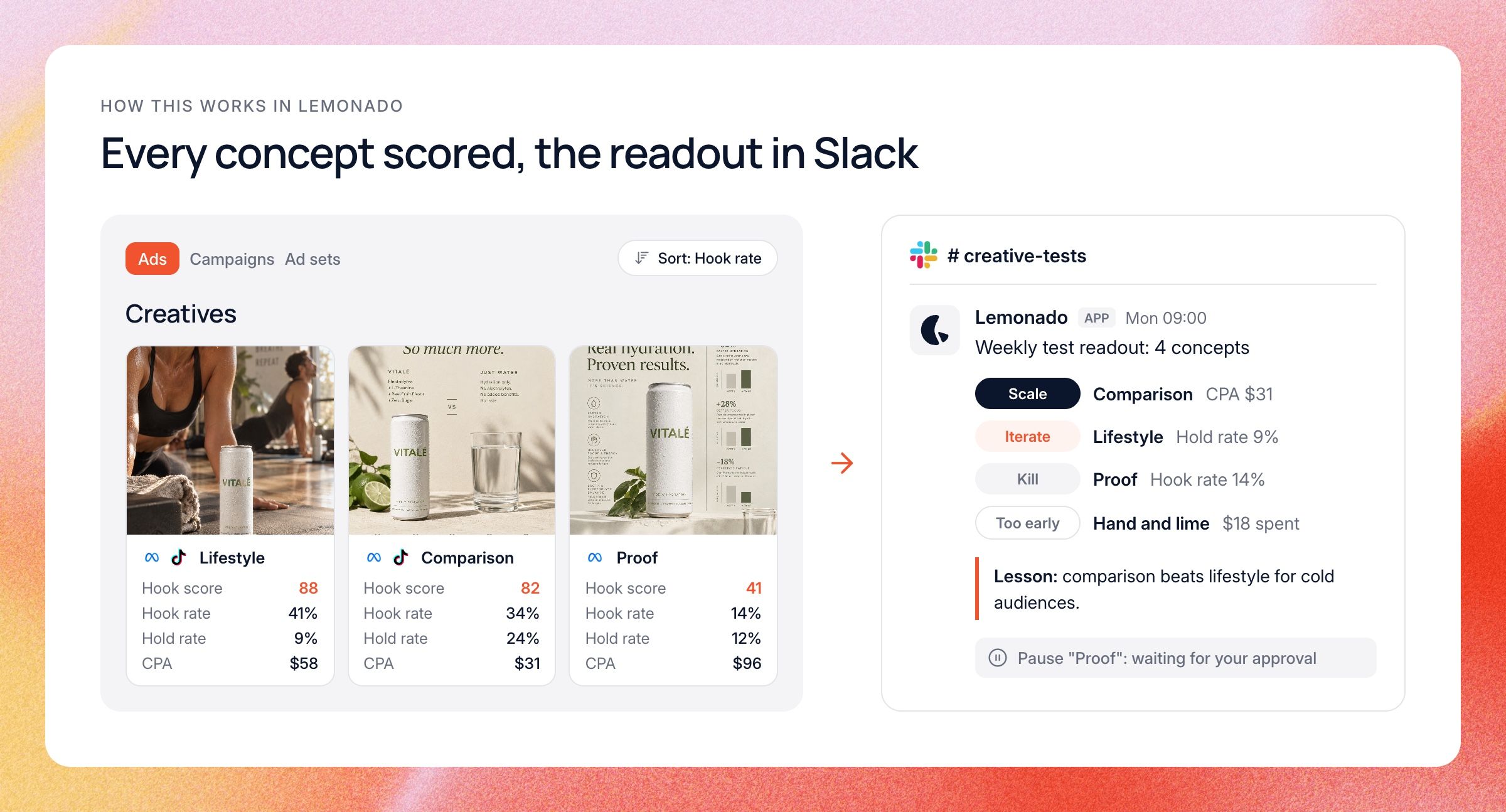
You can ask about any test the way you'd ask a colleague. Try "Which concept won last week's Meta test, and where did the losers drop off?" in Chat or straight from Slack. It pulls up the creatives, reads the numbers across every connected platform, and explains why one ad beat another.
The weekly readout is where most of the time goes, so hand it off. A Routine runs on a schedule and posts the result where your team already works. Here is one you can copy:
- "Every Monday at 9am, look at every ad launched in the last 14 days across Meta and TikTok. Group them by the concept name in the ad name. For each concept, show spend, hook rate, hold rate, CTR and cost per result. Label it Scale, Iterate, Kill or Too early, and post the readout with the main lesson in #creative-tests."
When a concept clearly loses, Lemonado can pause it for you. The change waits for your approval in Slack before anything happens. If you run tests for clients, you can turn the same readout into a live, shareable report in Studio. That's how many marketing agencies share test results without building decks.
FAQs
These are the questions we hear most from marketers setting up creative testing for the first time. The short answers below cover budget, timing, metrics and tools. If your question isn't here, the framework above usually has the longer version.
What is creative testing in marketing?
Creative testing is comparing different ads with real spend to learn which ones drive results at an acceptable cost. You change the creative and keep the rest of the setup the same. The goal is to find winners and learn why they won, so your next ads start from a better idea.
What is a good creative testing framework for Facebook ads?
Write a one-line hypothesis, decide if it's a concept or an iteration test, then set a budget, a time limit and one deciding metric before launch. Run it for at least seven days and judge early on hook rate and CTR, then on CPA. Log one lesson from every test so the next brief gets better.
How much budget do you need for creative testing?
A good starting point is to let each concept spend two to three times your target CPA before you judge it on cost. If that's too much, cut clear losers on hook rate and CTR first, then fund the survivors. Many teams set aside around 10 to 20 percent of their ad budget for testing, and adjust from there.
How long should a creative test run?
Seven days is a sensible minimum, because it covers a full week of buying behavior. The first day or two is noisy while the platform learns, so don't judge early. Set the end date before launch and stick to it.
What metrics matter most in creative testing?
Hook rate, hold rate, CTR and CPA, read in that order. The first three are early signals that tell you where the ad loses people. CPA (or ROAS) is the final judge, because attention only matters if it turns into sales or leads.
Is creative testing the same as A/B testing?
An A/B test is one way to run a creative test. It splits the audience so each person sees only one version, which gives a clean answer but costs more and takes longer. Many creative tests use lighter setups, like several concepts in one ad set, and accept a less strict split for speed.
What are the best ad creative testing platforms?
Start with the free testers built into Meta, TikTok and Google to run your tests. Add a creative analytics tool such as Lemonado, Motion or Superads to read why ads won, especially if you test on more than one platform. Rule-based tools like Birch help you act on results, and pre-testing tools like System1 suit big brand campaigns.
Find your next winner this week
Good creative testing means you learn faster than your budget burns. Write the hypothesis, test clearly different concepts, read the funnel from the top down, and log what you learned. Do that every week and finding the next winner gets a lot less random.
Try Lemonado free. Get $150 in credits, no card needed. Connect your ad accounts and see which of your concepts are winning and why.